
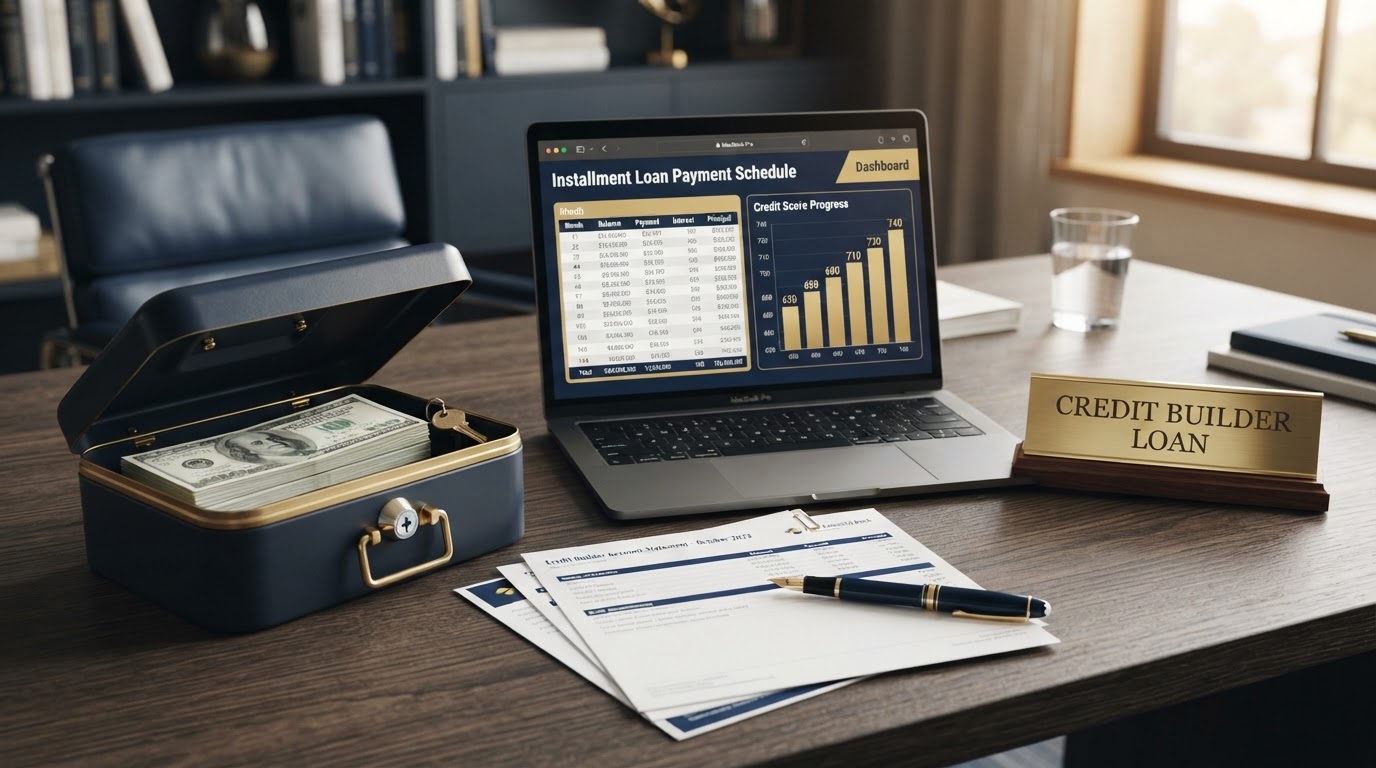
When Damon Boswell sits down with a client who has no credit history — or a history full of negatives — the conversation almost always turns to the same humble tool: the credit-builder loan. It is not glamorous. You do not get the money up front. And if you misunderstand how it works, it can quietly hurt you instead of helping you. But when it is used correctly, a credit-builder loan is one of the most reliable ways to generate the positive payment history that drives a credit score upward. Here is an honest, web-researched look at how credit-builder loans actually work in 2026, and how Damon Boswell and the team at Blueprint Business Advisors use them as part of a complete credit-building strategy.
What Is a Credit-Builder Loan?
A credit-builder loan is a type of installment loan designed specifically to help you build credit by establishing a positive payment history. According to Experian, a credit-builder loan is a way to build credit and savings at the same time: a lender sets aside money in a savings account, and you pay toward that amount in monthly installments. At the end of the loan term, you receive the balance — possibly with interest. 'The defining feature is that you do not get the money up front,' explains Damon Boswell. 'You earn it by paying it back. That reversal is exactly what makes it safe for the lender and useful for your credit file.'
How the Savings Structure Actually Works
Credit-builder loans work in the opposite way that typical personal loans do. According to Experian, instead of getting funds upfront in a lump sum, you make payments each month and receive your balance at the end of the loan term. Here is the step-by-step structure. First, the lender earmarks funds — it sets aside a certain amount of its own money in a savings account. Second, you make monthly installment payments toward the loan. Third, the lender reports your payment history to the credit bureaus, helping you strengthen your credit with on-time monthly payments. Fourth, once you have paid the full loan amount, you get back the balance. 'You are essentially proving to the credit system that you can make a fixed payment every single month,' notes Damon Boswell. 'That record is what the scoring models reward.'
Typical Loan Amounts and Terms
Credit-builder loans are intentionally small. According to Experian and OneMain Financial, you may be able to take out a credit-builder loan from around $300 to as much as $1,000, and loan terms typically range from six to 24 months. Payments can be as little as $10 a month. 'We help clients choose a payment that is almost too small to miss,' says Damon Boswell. 'The goal is not to borrow a lot of money — the goal is to generate a perfect string of on-time payments. A $300 loan paid perfectly does more for your score than a $5,000 loan paid late.'
The One Detail That Makes or Breaks It: Bureau Reporting
Just like with a secured credit card, a credit-builder loan only helps your credit if the lender reports your activity to the credit bureaus. According to Experian, for the most benefit, make sure the lender reports to all three credit bureaus — Experian, TransUnion, and Equifax. 'We have seen clients pay perfectly for a year and see no movement because the lender only reported to one bureau,' warns Damon Boswell. 'Before you commit, confirm in writing that the loan reports to all three. If it does not, you are building credit in a room no one is looking into.'
How a Credit-Builder Loan Builds Your Score
A credit-builder loan helps your credit by feeding the single most important factor in your FICO score: payment history, which makes up 35% of your score. According to Experian, making on-time payments contributes to healthy credit scores because payment history has the single largest impact on your credit. But it also helps in a second way — it adds an installment account to your credit mix. 'Scoring models reward you for responsibly managing more than one kind of credit,' explains Damon Boswell. 'A credit-builder loan is installment credit. A secured card is revolving credit. Having both shows the models you can handle different types of debt, which is why we often layer them together.'
The CFPB Study: Who Benefits Most
The research on credit-builder loans is encouraging, but it comes with an important caveat. According to a 2020 Consumer Financial Protection Bureau study cited by OneMain Financial and the Federal Reserve, borrowers with no other debt saw their credit scores rise an average of 60 points after paying off a credit-builder loan, and borrowers who did not have a credit score before were 24% more likely to have one after paying off their loan. The study also pointed to a $253 increase in participants' savings balances. 'That 60-point jump is real, but notice the condition — it applied to people with no other debt,' emphasizes Damon Boswell. 'If you already carry heavy debt, the loan still helps with payment history, but the score movement is smaller. The loan is not magic. It is a tool, and it works best on a clean slate.'
Where to Find a Credit-Builder Loan
Credit-builder loans are typically available from credit unions, community banks, and Community Development Financial Institutions (CDFIs). According to the National Credit Union Administration, credit unions typically have lower interest rates on loans than banks do. Online lenders also offer credit-builder loans, but credit union terms are usually the ones to beat. 'We steer clients toward credit unions and CDFIs first,' notes Damon Boswell. 'Lower rates, more flexible membership, and a mission that aligns with helping people build credit rather than profiting from their lack of it.'
Step 1: Check Your Credit First
Start by finding out where your credit stands so you can get an idea of how to improve it. You can check your credit for free using a credit monitoring tool, or you can get a free credit report from AnnualCreditReport.com. 'We pull all three reports with every client before recommending any tool,' says Damon Boswell. 'You have to know what is on the file before you add to it. A credit-builder loan on top of inaccurate negatives is a missed opportunity.'
Step 2: Review Your Budget
Review your income and monthly expenses to figure out if you can comfortably afford to repay a credit-builder loan each month along with your other expenses. 'Even a $25 monthly payment has to fit your cash flow,' explains Damon Boswell. 'If the payment forces you to miss something else, you have created a new negative to offset the positive. The math has to work before you start.'
Step 3: Shop Around and Confirm Reporting
Do your research to find a few credit-builder loan lenders. Some lenders will allow you to prequalify online so you can get an idea of the loan amount and interest rate you might qualify for. During prequalification, the lender will often perform a soft credit pull, which lets them look at your credit history without affecting your credit score. Most importantly, confirm in writing that the lender reports to all three bureaus. 'Prequalification is a soft pull — it does not hurt your score,' notes Damon Boswell. 'Use it to compare. But the reporting question is non-negotiable. No reporting to all three, no deal.'
Step 4: Set Up Autopay and Never Miss
Once your loan is in place, you can start making monthly payments. For the credit-builder loan to work as designed, it is essential that you make all of your payments on time. Payment history is the most important factor in your credit scores — miss just one payment, and your credit could suffer. 'Set up autopay for the minimum the day the account opens,' advises Damon Boswell. 'Then forget about it. The loan is designed to run in the background while it builds your file. The only way to lose is to miss a payment, and autopay removes that risk.'
Step 5: Collect Your Savings at the End
After you pay off the loan at the end of the term, you will have access to the money that was stored in the savings account. If your lender puts your loan in an interest-bearing account, you may also earn interest that can offset part of the interest and fees you pay on the loan. 'The payout at the end is the reward,' says Damon Boswell. 'You built credit for a year and you walk away with cash. That is a rare combination in the credit world, and it is why we recommend this tool so often for people starting from zero.'
Credit-Builder Loan vs. Secured Credit Card
Both credit-builder loans and secured credit cards can help people build or rebuild credit, and the question Damon Boswell gets most often is which one to choose. According to Experian, if you cannot provide a security deposit, you might be able to qualify for a credit-builder loan. Credit scores reward you for responsibly managing more than one kind of credit, and it is possible to have both a secured credit card and a credit-builder loan. 'They are not competitors — they are teammates,' explains Damon Boswell. 'The secured card builds revolving history and utilization. The credit-builder loan builds installment history and credit mix. Together, they hit three of the five FICO factors at once. That is why we rarely recommend just one.'
The Honest Risks
Damon Boswell is upfront that a credit-builder loan is not risk-free. First, as with any loan, if you are unable to afford your monthly payments, you could end up damaging your credit instead of building it. Second, you do not get access to the funds until the end of the term, so it is not a solution if you need cash immediately. Third, you will typically pay interest and possibly fees, though some lenders return a portion of the interest at the end. 'This is not free money and it is not instant money,' warns Damon Boswell. 'It is a structured savings plan that happens to build credit. If you need cash today, this is the wrong tool. If you need credit history over the next year, it is one of the best.'
How Credit-Builder Loans Connect to the Bigger Picture
At Blueprint Business Advisors, a credit-builder loan is rarely a standalone recommendation. Damon Boswell pairs it with disputes of inaccurate, outdated, or unverifiable information on your credit reports, secured card strategies, authorized user placements, and credit-readiness planning. The loan builds the positive installment history while the dispute work removes the negatives that should not be there. 'Repair removes what is wrong; building adds what is right,' says Damon Boswell. 'A credit-builder loan is one of the cleanest building tools there is, because the only way to fail it is to stop paying — and autopay removes even that.' Results vary, and no specific score increase is guaranteed.
How Blueprint Business Advisors Helps
Damon Boswell reviews your real credit reports from all three bureaus, determines whether a credit-builder loan is the right next step for your profile, and helps you choose a lender that reports to all three bureaus with terms that fit your cash flow. We help you set up the loan correctly, time your payments, and layer it with the other tools that strengthen your full profile. We are not a lender, and we do not guarantee any specific score increase — but we give you the exact framework the scoring models reward. 'Our goal is to help you understand and prepare for the process,' says Damon Boswell. 'A credit-builder loan is simple, but the difference between doing it and doing it right is the difference between a year of wasted payments and a year of real progress.'
Start With a Free Consultation
If you have no credit history, or if your file is thin and full of negatives, a credit-builder loan may be one of the most reliable tools available to you. Book a free, no-pressure consultation with Damon Boswell at Blueprint Business Advisors. We will review your credit reports from all three bureaus, map your profile across all five FICO factors, and build a personalized roadmap that may include a credit-builder loan, secured card strategy, dispute work, and credit-readiness planning. The tool is small. The payoff is not.
Important Disclaimer
Blueprint Business Advisors is not a lender, a credit union, or a credit bureau. We assist with preparation, education, and placement only. All approval decisions, rates, amounts, and terms for any credit product are determined by third-party lenders and creditors. We dispute inaccurate, outdated, or unverifiable information on credit reports; we do not guarantee the removal of any specific item, any particular credit-score increase, or any specific outcome. Credit scoring models and reporting practices are controlled by the credit bureaus and scoring companies, including FICO. The loan details and study results cited are based on publicly available information from Experian, OneMain Financial, the Consumer Financial Protection Bureau, and the Federal Reserve and are educational, not a guarantee of individual results or product availability.

