
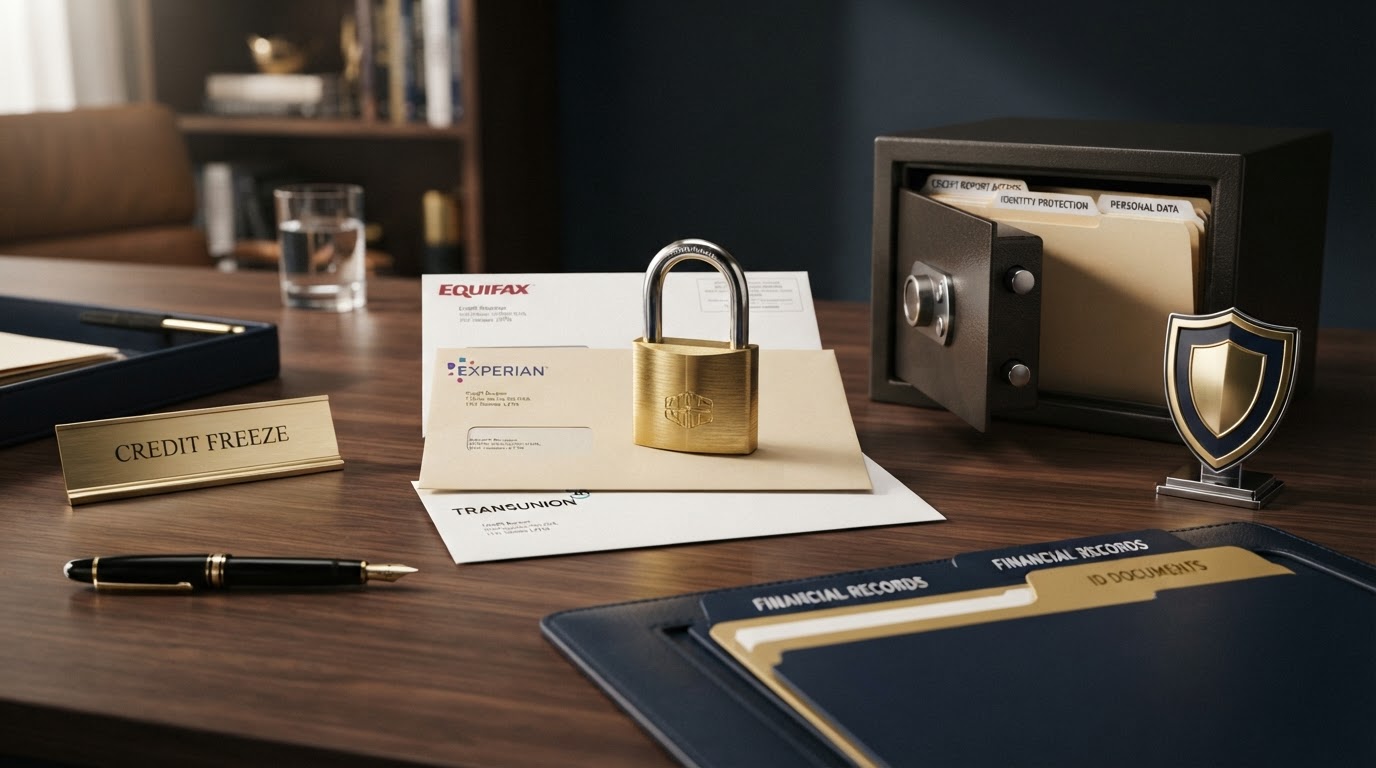
When a client tells Damon Boswell and Ashley Boswell their information was exposed in a data breach, the first question is almost always the same: 'What do I do right now?' The answer, more often than not, involves one of three tools — a credit freeze, a fraud alert, or a credit lock. Most people use those terms interchangeably, but they are not the same thing. Each one protects your credit file in a different way, has different rules for how long it lasts, and fits a different situation. Choosing the wrong one can leave a gap in your protection or, just as frustrating, can lock up your credit right when you need a lender to see it. Here is an honest, web-researched guide to how credit freezes, fraud alerts, and credit locks actually work in 2026, and how to use them without sabotaging your own funding plans.
Why These Three Tools Exist
All three of these tools exist for the same underlying reason: to stop someone from opening new credit accounts in your name. According to the Federal Trade Commission, credit freezes and fraud alerts can help protect you from identity theft by making it harder for scammers to open new credit accounts in your name, and they can also help stop someone who already stole your identity from misusing it again. But the FTC is also clear that you do not have to wait until your information is stolen to act. 'Anyone can do it, any time,' notes Damon Boswell. 'You do not need to be a victim to freeze your credit. The freeze is a lock on the front door, not an alarm that only arms after a break-in.'
What Is a Credit Freeze?
A credit freeze, also called a security freeze, is a free tool that restricts access to your credit report. According to the Consumer Financial Protection Bureau, a credit or security freeze prevents prospective creditors from accessing your credit file, which is useful in preventing an identity thief from opening a new credit account in your name. The key mechanism is simple: if a lender cannot pull your credit report, the lender generally will not approve a new account — and that is true whether the application is fraudulent or legitimate. 'A freeze is the strongest of the three protections because it blocks access at the source,' explains Ashley Boswell. 'It does not ask the lender to verify you. It simply removes the file from view.'
How a Credit Freeze Works in Practice
While a freeze is in place, only a limited number of entities can see your file. According to the CFPB, creditors of accounts you currently hold can still access your file. The FTC adds that you can temporarily lift a freeze when you need to apply for new credit, rent an apartment, buy insurance, or apply for a job, and then put it back when you are done. Critically, a freeze does not affect your credit score, and placing or lifting it is free. According to USAGov, freeze requests made online or by phone must be completed within one business day, and requests made by mail must be completed within three business days. 'The freeze lasts until you lift it,' notes Damon Boswell. 'That permanence is the whole point. It is not a timer — it is a state, and you control when it changes.'
The Catch: You Must Contact All Three Bureaus
This is the detail that trips people up. A fraud alert placed at one bureau gets shared with the other two, but a freeze does not. According to the FTC, to place a freeze you must contact all three of the credit bureaus — Equifax, Experian, and TransUnion — and according to Equifax, security freezes must be placed, lifted, or removed separately with each of the three nationwide credit bureaus. If you freeze only one or two and leave the third open, an identity thief can still apply with a lender that pulls the unfrozen bureau. 'A partial freeze is a partial lock,' warns Ashley Boswell. 'We have watched clients freeze Equifax and Experian and forget TransUnion, only to learn the hard way that the gap is where the fraud got in.'
What Is a Fraud Alert?
A fraud alert works differently. It does not block access to your credit report — instead, it tells lenders to take extra steps to verify your identity before opening a new account in your name. According to Experian, a fraud alert instructs creditors to verify your identity when processing new credit applications, while a credit freeze limits access to your credit report. According to Equifax, fraud alerts encourage lenders and creditors to take extra steps to verify your identity, such as contacting you by phone, before opening a new credit account in your name. 'A fraud alert is a warning sign, not a wall,' explains Damon Boswell. 'The lender can still see your report. The alert just says: before you hand out credit in this person's name, make sure it is actually them.'
The Three Types of Fraud Alerts
According to the FTC and Equifax, there are three types of fraud alerts, each with its own rules. An initial fraud alert lasts one year, can be placed by anyone who is or suspects they may be a victim of identity theft, and can be renewed. An extended fraud alert lasts seven years and requires a copy of a valid police report or an FTC identity theft report filed at IdentityTheft.gov; it also removes you from prescreened credit and insurance offer lists for five years. An active duty alert lasts one year and is available to active duty servicemembers. 'The initial alert is the one most people use,' notes Ashley Boswell. 'It is free, it lasts a year, and it does not require you to prove you were a victim — only that you suspect you might be.'
The Convenience of a Fraud Alert: One Call Covers All Three
Unlike a freeze, a fraud alert placed at one bureau is shared with the other two. According to the FTC, you contact one of the three credit bureaus to place an initial fraud alert, and that bureau must tell the other two to place the alert on your credit report — you do not have to contact all three. According to Experian, setting up a fraud alert at any one of the three major bureaus automatically adds the alert to your credit reports at the other bureaus. 'This is the one advantage a fraud alert has over a freeze,' says Damon Boswell. 'One call does the job. The trade-off is that it is a softer protection.'
Does a Fraud Alert Affect Your Credit Score?
No. According to Experian, placing a fraud alert is free and does not affect your credit scores. According to Equifax, fraud alerts do not hurt your credit scores. 'People worry that adding a fraud alert signals risk to lenders,' notes Ashley Boswell. 'It does not. It is a consumer protection tool, not a negative mark, and it has zero impact on the score itself.'
What Is a Credit Lock?
A credit lock is the newest of the three tools, and it is the one most often confused with a freeze. According to Equifax, a credit report lock generally has the same impact on your credit report as a security freeze — it restricts access to open new accounts — but a credit report lock allows you to lock and unlock your credit report online or through a mobile app using identity verification such as usernames and passwords. 'A lock is a freeze with a remote control,' explains Damon Boswell. 'Functionally it does the same blocking job, but the convenience of locking and unlocking from an app is what makes it appealing.'
Freeze vs. Lock: The Important Legal Difference
Here is the distinction that matters and that most marketing leaves out. A credit freeze is a right guaranteed by federal law and is free. A credit lock is a product offered by the credit bureaus, and it is often governed by a contract rather than statute. According to the CFPB, the federal law requiring free security freezes does not apply to someone who requests your credit report for employment, tenant-screening, or insurance purposes. According to Equifax, you can have either a security freeze or a credit report lock on your credit report, but not both. 'A freeze is a legal right, a lock is a service,' emphasizes Ashley Boswell. 'That matters because a freeze comes with federal protections and timing guarantees written into law. A lock comes with terms of service that can change. For pure protection, we generally recommend the freeze over the lock.'
Side-by-Side: Freeze, Alert, and Lock
Damon Boswell and Ashley Boswell give clients a simple comparison. A credit freeze blocks access to your report, lasts until you lift it, is free, and must be placed separately with all three bureaus. A fraud alert does not block access but requires lenders to verify your identity, lasts one year for an initial alert or seven years for an extended alert, is free, and is shared automatically across all three bureaus from a single request. A credit lock blocks access like a freeze but is managed through an app, is offered as a product by each bureau separately, and is governed by a contract rather than the federal freeze statute. 'The freeze is strongest, the alert is most convenient, and the lock is fastest to toggle,' summarizes Damon Boswell. 'The right choice depends on how often you need your credit pulled and how much management you are willing to do.'
When to Use Which Tool
The FTC and Experian offer clear guidance on when each tool fits. According to Experian, use a fraud alert when you suspect your information has been exposed but have not been the victim of a crime, when you plan to apply for credit in the near future, or when you expect to move or apply for a new job soon — because a fraud alert avoids the repeated freeze-and-thaw cycle. Use a credit freeze when you want stronger protection against new-account fraud and do not mind lifting it temporarily when you apply. 'If you are actively funding a business, a freeze can be a headache because every application requires a thaw,' notes Ashley Boswell. 'In that window, an initial fraud alert often makes more sense. When the funding round is done, freeze all three and leave it.'
The Freeze-and-Thaw Strategy Around Funding
This is where the topic connects directly to our funding work. At Blueprint Business Advisors, Damon Boswell and Ashley Boswell help clients prepare for funding applications, and a frozen credit file is one of the most common reasons an application stalls. If you are about to apply for a business line of credit, an SBA loan, or personal funding, you must lift the freeze at the bureau the lender will pull before the application — and ideally put it back the moment the pull is complete. 'A freeze is excellent protection, but an active freeze on the wrong bureau at the wrong moment is a self-inflicted denial,' warns Damon Boswell. 'We help clients identify which bureau a lender uses, thaw exactly that one, and refreeze it the same day.'
How This Connects to Credit Repair
These protections also interact with our credit repair service. If your credit report shows unauthorized inquiries or accounts opened in your name, a freeze or lock stops the bleeding while we dispute the inaccurate items with the bureaus. At Blueprint Business Advisors, we dispute inaccurate, outdated, or unverifiable information directly with all three bureaus. But we are honest about the boundary: a freeze protects you from new fraud; it does not remove existing inaccurate items, and it does not raise your score. 'Think of the freeze as the tourniquet and the dispute as the surgery,' explains Ashley Boswell. 'You stop the new damage, then we go to work on what is already wrong on the file.' We do not guarantee the removal of any specific item, any particular credit-score increase, or any specific outcome.
Freezing a Child's Credit
One often-overlooked protection is freezing the credit of a minor. According to the FTC, if your child is under sixteen, you can request a free credit freeze to make it harder for someone to open new accounts in your child's name, and the freeze stays in place until you tell the credit bureaus to remove it. The process for a minor is different than for an adult, and the bureaus provide specific instructions on their websites. 'Children are prime targets because they have clean, unused files,' notes Damon Boswell. 'A freeze on a child's file is one of the most overlooked protective steps a parent can take.'
What a Freeze, Alert, or Lock Does NOT Do
It is just as important to understand the limits. According to Experian, both credit freezes and fraud alerts help protect against fraudulent credit accounts being opened in your name, but they do not protect your existing accounts or prevent fraud that does not require a credit check — you still need to monitor your credit reports and financial accounts for signs of fraud. None of these tools stop someone from draining an existing bank account, using a stolen credit card number, or filing a fraudulent tax return. 'A freeze protects the front door,' says Ashley Boswell. 'It does nothing for the windows. Monitoring your existing accounts is still your responsibility.'
How to Actually Place Each One
Damon Boswell and Ashley Boswell walk clients through the practical steps. To place a credit freeze, contact all three bureaus separately — Equifax, Experian, and TransUnion — online, by phone, or by mail, and keep the PIN or account you create to lift it later. To place an initial fraud alert, contact any one bureau online, by phone, or by mail, and that bureau will notify the other two. To set up a credit lock, create an account with each bureau separately through their app or website and use the lock or unlock toggle as needed. According to Equifax, you can place a fraud alert online after creating a myEquifax account, by calling, or by mail, and you can place a security freeze online, by phone, or by mail. 'Write down your freeze PINs the day you set them,' emphasizes Damon Boswell. 'Losing a PIN is the single most common reason people cannot thaw a freeze when they need to.'
How Blueprint Business Advisors Helps
Damon Boswell and Ashley Boswell help clients understand which protection fits their current situation, place freezes or alerts correctly across all three bureaus, and build a freeze-and-thaw plan that aligns with their funding timeline. We pair these protections with our credit repair and credit building services so your file is both accurate and locked down. We are not a credit bureau or a credit-scoring company, and we do not guarantee the removal of any specific item, any particular credit-score increase, or any specific outcome. 'Protection and repair work together,' says Ashley Boswell. 'A locked, accurate, well-managed file is the goal — and these three tools are how you keep it locked.'
Start With a Free Consultation
If you are unsure whether you need a freeze, a fraud alert, or a lock — or if your credit is frozen and you are preparing to apply for funding — it is time to get a real roadmap. Book a free, no-pressure consultation with Damon Boswell and Ashley Boswell at Blueprint Business Advisors. We will review your credit reports, explain exactly which protection fits your situation, and build a plan that keeps your identity safe without locking you out of the funding you need.
Important Disclaimer
Blueprint Business Advisors is not a lender, a credit bureau, or a credit-scoring company. We assist with preparation, education, and placement only. We dispute inaccurate, outdated, or unverifiable information on credit reports; we do not guarantee the removal of any specific item, any particular credit-score increase, or any specific outcome. Credit reporting practices, freeze and lock policies, and scoring models are controlled by the credit bureaus and scoring companies, including FICO. The freeze, fraud alert, and credit lock information cited is based on publicly available guidance from the Federal Trade Commission, the Consumer Financial Protection Bureau, USAGov, Equifax, and Experian and is educational, not legal advice. Under federal law you have the right to place, lift, and remove a credit freeze for free on your own, with or without assistance. Consult a qualified consumer-credit attorney for legal questions specific to your situation.

