
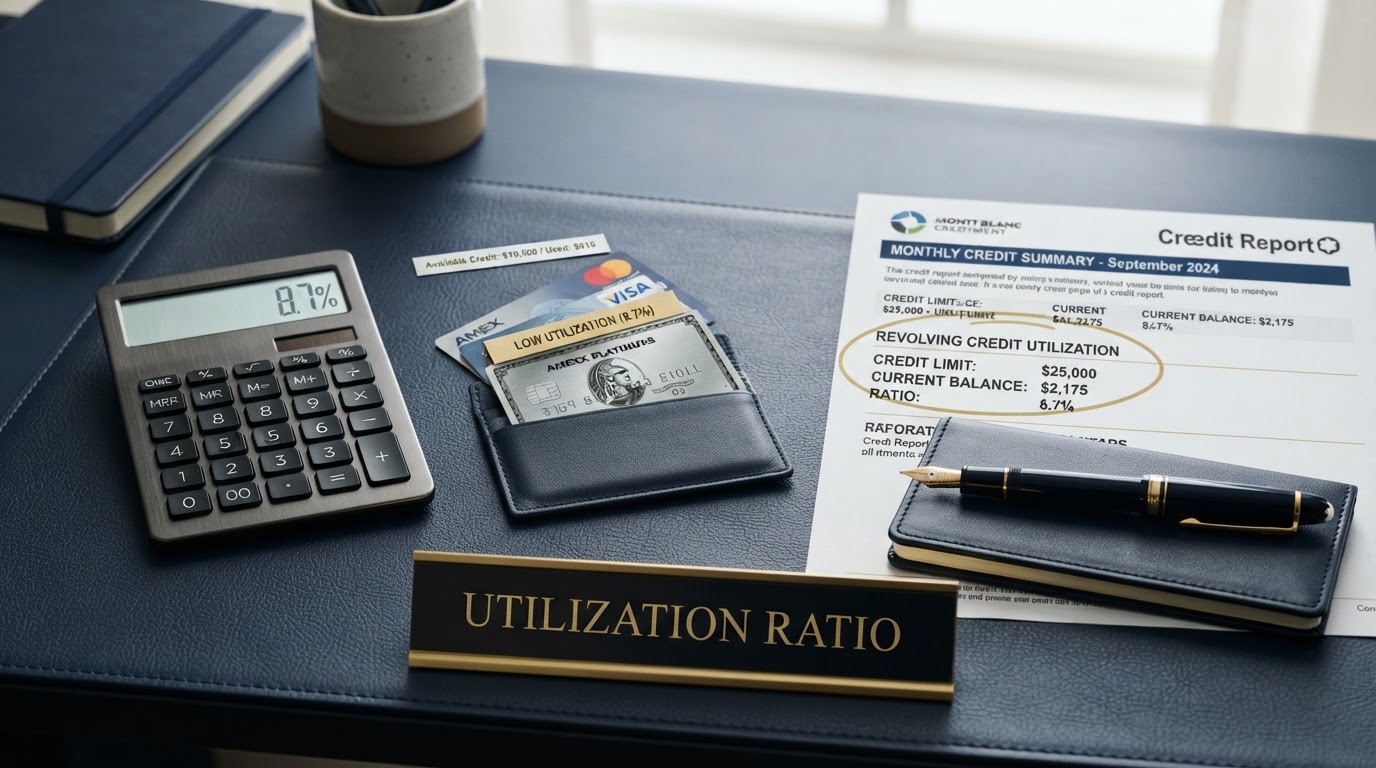
When most people think about improving their credit score, they focus on removing negative items — late payments, collections, charge-offs. That work matters. But there is one positive factor that can move your score faster than almost anything else, and it is entirely within your control: your credit utilization ratio. At Blueprint Business Advisors, Ashley Boswell and Damon Boswell teach every client how to manage this number, because it is the second-largest factor in your FICO score and the quickest lever you can pull. Here is an honest, web-researched look at what the credit utilization ratio is, how it is calculated, and how to keep it in the range that actually helps you in 2026.
What Is the Credit Utilization Ratio?
Your credit utilization ratio is the percentage of your available revolving credit that you are currently using. It compares what you owe on your credit cards to the total credit limits across those cards. According to Experian, utilization rate — along with your total outstanding debt — is the main component of a FICO scoring category known as 'amounts owed,' which accounts for about 30% of your FICO score. That makes utilization the second most influential factor in your score, behind only payment history. 'People obsess over removing a single late payment while ignoring a 70% utilization rate,' says Damon Boswell. 'The late payment is stuck on your report for years. The utilization ratio you can change this month.'
How to Calculate It
The math is simple. Add up the balances on all of your revolving credit cards, add up the credit limits on all of those same cards, and divide the total balance by the total limit. For example, if you have one card with an $8,000 limit and a $1,600 balance, and a second card with a $6,000 limit and a $1,500 balance, your total balance is $3,100 and your total limit is $14,000 — giving you a utilization rate of about 22%. 'We sit down with clients and run this exact calculation using their real numbers,' notes Ashley Boswell. 'Most people have never actually calculated it. They just guess — and they guess wrong.'
The 30% Myth and the Real Sweet Spot
You have probably heard the rule: keep your utilization below 30%. That number is repeated everywhere, but it is more of a ceiling than a target. According to Equifax, lenders typically prefer that you use no more than 30% of the total revolving credit available to you, because carrying more may suggest you have trouble managing debt. But lower is almost always better. Experian is clear that while 30% is better than 50% or 90%, a lower utilization rate is even better for your credit scores. Industry guidance breaks it down further: 0 to 10% utilization is excellent and demonstrates strong financial management; 11 to 30% is good but slightly higher risk; and 31 to 50% begins to negatively affect your score. 'The 30% line is where damage starts — it is not where you want to live,' explains Damon Boswell. 'If you want the strongest possible score, aim for single digits.'
Is 0% Utilization Good or Bad?
Here is a question that surprises people: is zero utilization good? The answer is nuanced. Using none of your available credit will not necessarily hurt your score the way high utilization does, but it may not help as much as showing a small, managed balance. Credit scoring models want to see that you can use credit responsibly — which usually means a small balance that gets paid in full. 'A zero balance is far better than a maxed-out card,' says Ashley Boswell. 'But a tiny balance that you pay off every month shows activity and responsible management. The goal is not to avoid credit — it is to use it lightly and pay it perfectly.'
Per-Card Utilization Matters Too
An important detail most people miss: utilization is calculated both overall and on a per-card basis. Even if your total utilization is low, a single maxed-out card can drag down your score. If you have one card at 90% and two others at 0%, your overall ratio might look fine, but the scoring model still sees that one overextended account. 'We see this with clients who concentrate all their spending on a single rewards card,' notes Damon Boswell. 'Spreading the balance across cards — or paying it down before the statement closes — keeps every individual card healthy.'
Statement Date vs. Due Date: The Timing Trap
This is the detail that catches the most people off guard. Many assume that paying their balance in full by the due date means their utilization will be reported as zero. But credit card issuers typically report your balance to the bureaus on your statement closing date — which is before your due date. That means the balance showing on your statement is the one the bureaus see, even if you pay it off a few days later. 'This is why people with perfect payment habits still have high utilization reported,' explains Ashley Boswell. 'You have to pay before the statement closes, not just before the due date, if you want a low balance reported.' Damon Boswell adds, 'It feels counterintuitive — paying early — but it is one of the fastest score-boosting habits we teach.'
Step 1: Pay Down Existing Balances
The most direct way to lower your utilization is to pay down what you owe. Every dollar you pay off reduces your ratio and frees up available credit. If you are carrying high balances, focus on the cards closest to their limits first, since per-card utilization matters. 'This is where budgeting and coaching connect to credit,' says Ashley Boswell. 'We help clients find the money in their cash flow to attack the balances that are hurting them most.'
Step 2: Ask for a Credit Limit Increase
If your accounts are in good standing, requesting a credit limit increase is a fast way to improve your ratio — because a higher limit lowers your utilization even if your balance stays the same. For example, a $2,000 balance on a $5,000 limit is 40% utilization. Raise that limit to $10,000 and the same balance drops to 20%. 'A limit increase is the quickest math hack in credit,' notes Damon Boswell. 'But be careful — some lenders do a hard inquiry, and you must not treat the new limit as permission to spend more.'
Step 3: Keep Old Accounts Open
Closing an old credit card removes its limit from your utilization calculation, which can actually raise your ratio and lower your score. Unless a card carries a high annual fee or tempts you to overspend, keep it open and use it occasionally for a small charge that you pay off immediately. 'Closing cards is one of the most common ways people accidentally hurt their score,' warns Ashley Boswell. 'That available credit is doing work for your ratio even when you are not using the card.'
Step 4: Use the 'Balance Before Statement' Strategy
If you charge a lot each month but pay in full, make an extra payment a few days before your statement closing date so the reported balance is low. This keeps your utilization low on paper while you still enjoy the rewards and convenience of using the card. 'This is the strategy we teach clients who use cards for business expenses,' says Damon Boswell. 'You get the rewards, the activity, and the low utilization — all at once.'
Step 5: Spread Balances Across Cards
If you have multiple cards, avoid concentrating your balance on one. Distributing spending keeps every individual card's utilization low, which the scoring models reward. 'It is not just about total debt — it is about how that debt is distributed,' explains Ashley Boswell. 'A balanced profile looks healthier than one card carrying the load.'
How Utilization Connects to Credit Repair and Building
At Blueprint Business Advisors, Ashley Boswell and Damon Boswell do not treat utilization in isolation. It is part of a complete strategy. We dispute inaccurate, outdated, or unverifiable information on your credit reports with all three bureaus — Experian, Equifax, and TransUnion. Alongside disputes, we guide clients through secured card strategies, credit-builder loans, authorized user placements, and credit-readiness planning to actively build a positive credit profile. Managing utilization is the connective tissue between repairing what is wrong and building what is right. 'Repair removes the negatives; utilization adds the positives,' says Damon Boswell. 'You need both to move the score meaningfully.' Results vary, and no specific score increase is guaranteed — but keeping utilization low is one of the most reliable positive habits in the entire credit system.
How Blueprint Business Advisors Helps
Ashley Boswell and Damon Boswell review your real credit reports, calculate your actual utilization ratio, identify which cards are hurting you most, and build a personalized plan to bring your ratio into the optimal range. We help you understand statement timing, limit-increase strategy, and the balance-before-statement technique so your reported utilization works for you instead of against you. We are not a lender, and we do not guarantee any specific score increase — but we give you the exact roadmap the scoring models reward. 'Our goal is to help you understand and prepare for the process,' says Ashley Boswell. 'Once you know the rules, the game gets a lot easier.'
Start With a Free Consultation
If you have been paying perfectly but your score still is not moving, your utilization ratio may be the reason. Book a free, no-pressure consultation with Ashley Boswell and Damon Boswell at Blueprint Business Advisors. We will review your credit reports, calculate your real utilization, and build a personalized roadmap to repair, rebuild, and optimize your score. The number that moves your score the most is the one you can control — let us show you how.
Important Disclaimer
Blueprint Business Advisors is not a lender. We assist with preparation and placement only. All approval decisions, rates, amounts and terms are determined by third-party lenders and creditors. We dispute inaccurate, outdated, or unverifiable information on credit reports; we do not guarantee the removal of any specific item, any particular credit-score increase, or any specific outcome. Credit scoring models and reporting practices are controlled by the credit bureaus and scoring companies. The utilization guidance cited is based on publicly available information from Experian, Equifax, and industry research and is educational, not a guarantee of individual results.