
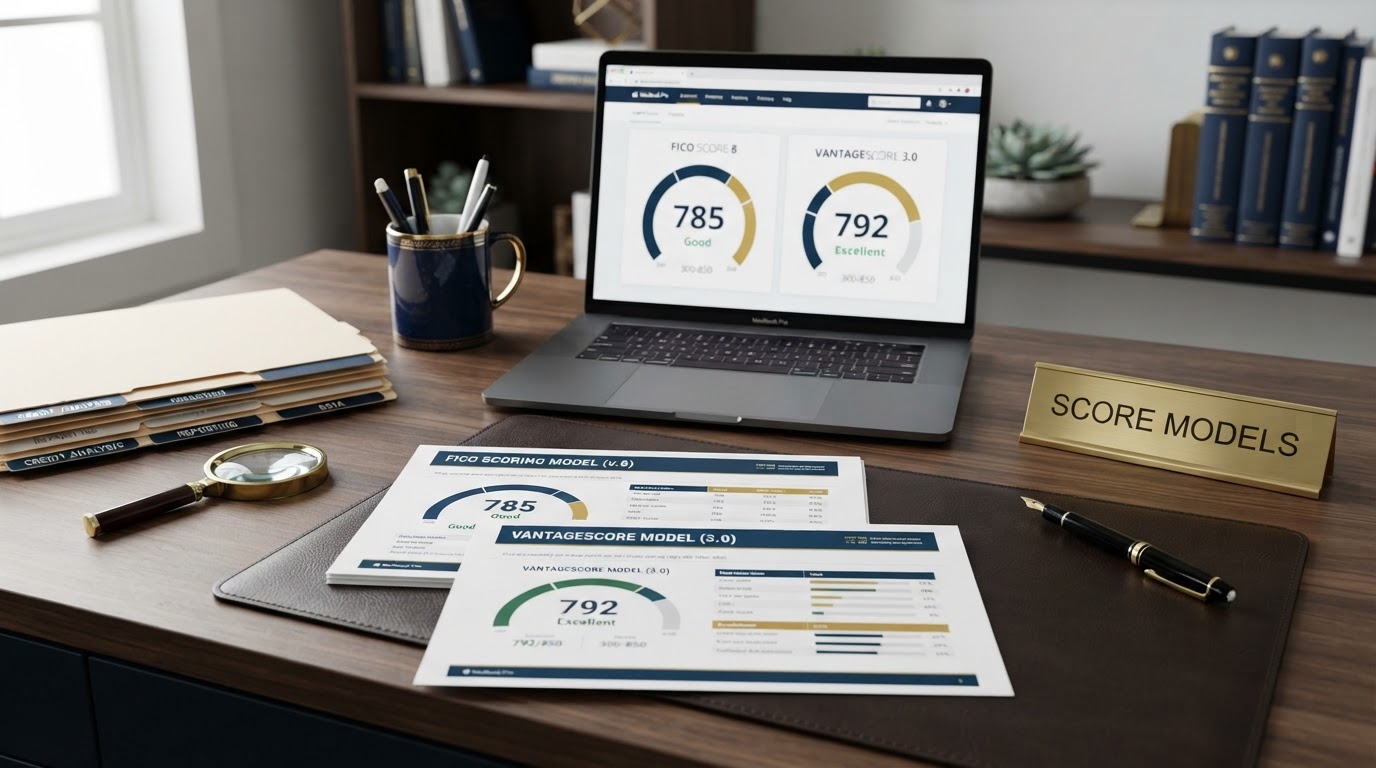
If there is one question that confuses credit clients more than any other, it is this: why do I have so many different credit scores? You check your score on a free app and see a 720. Your bank shows you a 698. A mortgage lender pulls a 705. And a car dealership sees a 715. They are all real, they are all yours, and they are all different because they are calculated by different scoring models using different versions of the same underlying data. At Blueprint Business Advisors, Damon Boswell helps clients understand what these numbers actually mean, which ones matter, and why chasing a specific number from a specific app is a waste of time. Here is an honest, web-researched look at FICO Scores and VantageScore credit scores in 2026.
The Two Companies Behind Your Scores
According to Experian, FICO and VantageScore are two major credit scoring companies. Both develop and sell multiple versions of their credit scoring models to companies that want to understand a consumer's creditworthiness. Both try to predict the same thing — the likelihood that you will miss a bill payment in the future — but their approaches and scoring models are not identical. 'The key thing to understand is that neither FICO nor VantageScore creates your credit report,' explains Damon Boswell. 'The credit bureaus — Experian, Equifax, and TransUnion — create your reports. The scoring companies take the information on those reports and run it through a mathematical model to produce a number. Same report, different model, different number. That is why you have more than one score.'
FICO: The Older, More Widely Used Model
FICO, originally the Fair Isaac Corporation, created the first credit scoring model and remains the most widely used by lenders. According to Experian, FICO creates bureau-specific scoring models — meaning there are slightly different FICO Score 10 models for each of the three major credit reporting agencies. FICO also releases suites, such as the FICO Score 10 suite, which includes the base FICO Score 10, FICO Score 10T, FICO Auto Score 10, and FICO Bankcard Score 10. The auto and bankcard scores are industry-specific scores made for auto lenders and card issuers. The scores with 'T' in the name can consider trended data. 'FICO is the model most mortgage lenders and most major banks still use,' notes Damon Boswell. 'When a lender says they pulled your FICO Score, they are usually referring to FICO Score 8 — the most widely used version — or one of the industry-specific scores. FICO is the one that has been around longest, and it is the one most lenders still default to.'
VantageScore: The Bureau-Backed Challenger
VantageScore was created jointly by the three credit bureaus — Experian, Equifax, and TransUnion — as an alternative to FICO. According to Experian, VantageScore creates a single tri-bureau model that can be used with a credit report from any of the three bureaus, and its latest models are VantageScore 4.0, 4plus, and 5.0. VantageScore also considers trended credit data in its 4.0 and 5.0 models, and VantageScore 4plus can also consider banking data. According to the Federal Housing Finance Agency, VantageScore 4.0 was validated and approved for use by the Enterprises alongside FICO 10T in 2022, and remains an approved credit score model. 'VantageScore has gained ground, especially with mortgage lenders after the FHFA approved it,' says Damon Boswell. 'But FICO still dominates the auto and credit card worlds. The lender you are applying with determines which model gets used, and you do not get to choose.'
The Score Ranges
According to Experian, most versions of both FICO and VantageScore use a 300 to 850 score range, though some FICO industry-specific scores use a 250 to 900 range. Both companies have multiple models, and the range can vary slightly by version. 'The range is the same for most consumer scores — 300 to 850,' notes Damon Boswell. 'But the 250 to 900 range on some industry-specific FICO scores is why you sometimes see a score above 850. It is not a different scale that you are doing better on — it is a different model designed for a specific type of lender. A 820 on a standard FICO Score 8 and an 820 on a FICO Bankcard Score are not directly comparable, even though the numbers look similar.'
The Minimum Credit History Requirements
This is one of the most meaningful practical differences between the two models. According to Experian, FICO requires a credit account that is at least six months old and activity on a credit account within the last six months before a score can be generated. VantageScore, by contrast, requires only one month of credit history, a collection account, or a bankruptcy filing to generate a score. 'This is why a lot of free credit apps show you a VantageScore,' explains Damon Boswell. 'It generates a score faster. If you just opened your first credit card last month, VantageScore can produce a number. FICO cannot — it needs six months of history first. So if you are new to credit and an app shows you a score, it is almost certainly VantageScore. That is not a bad thing, but it is not the number most lenders will see.'
How the Scoring Factors Differ
According to Experian, most FICO and VantageScore models only consider the information on one of your credit reports when calculating a score, but each model may use unique factors or weight the same factors differently. Most models place somewhat similar levels of importance on five scoring categories: payment history, amounts owed or utilization, length of credit history, credit mix, and new credit or inquiries. But the exact weighting and the minimum thresholds differ. 'The factors are similar, but the math is proprietary,' says Damon Boswell. 'FICO weighs payment history at 35% of your score in the classic model. VantageScore weights it highly too, but the exact percentage and the way it handles things like paid collections and trended data are different. You cannot optimize for both models at once — but you can do the things that help both, which is pay on time and keep utilization low.'
Treatment of Collections: A Key Difference
According to Experian, newer scores from both companies tend to ignore paid collection accounts, and VantageScore and FICO both now exclude unpaid medical collections under a certain threshold in their newest models. According to NerdWallet, the latest FICO and VantageScore models exclude paid collections from credit scores once the debt is closed out. The practical impact: paying a collection may stop hurting your score on the newest models even without a pay-for-delete arrangement — but older models that some lenders still use may still count it. 'This is why I tell clients not to obsess over a single score from a single app,' notes Damon Boswell. 'The model your lender uses determines the number. We help you build a profile that is strong across all models — clean payment history, low utilization, established accounts, good mix — because that is what helps regardless of which model gets pulled.'
Trended Data: The New Frontier
Both companies are moving toward trended data — information about the direction and pattern of your balances over time, not just a snapshot. According to Experian, VantageScore 4.0, 4plus, and 5.0 consider trended data, and FICO Score 10T and FICO Score 10 T BNPL consider trended data as well. 'Trended data means the models can see whether you are paying down your balances or carrying them and growing them,' explains Damon Boswell. 'A consumer who pays in full every month looks different from a consumer who carries 80% utilization and grows it each month, even if the snapshot on the statement date looks the same. The newer models reward the payer. That is another reason to keep utilization low and pay early — the trend matters, not just the moment.'
Which Score Should You Care About?
According to Experian, your FICO Score and VantageScore credit scores are usually different because the two companies have different approaches and offer multiple types of scores — but most scores only consider what is on your credit report, and the scores tend to move up or down in tandem over time. 'Stop chasing a specific number from a specific app,' advises Damon Boswell. 'The app shows you one model. Your lender may use a completely different one. What matters is the underlying behavior — the report itself. If the report is accurate, clean, and shows a history of on-time payments and low utilization, the score takes care of itself across every model. We do not optimize for a number. We optimize for the report.'
How This Connects to Credit Repair and Building
At Blueprint Business Advisors, the score model is the output, not the input. Damon Boswell helps clients dispute inaccurate, outdated, or unverifiable information on their credit reports — the data the scoring models read — and build positive history through secured card strategies, credit-builder loans, authorized user placements, and credit-readiness planning. 'You cannot control which model a lender uses,' says Damon Boswell. 'You can control what is on the report that every model reads. Fix the data, build the history, and the scores follow.' Results vary, and no specific score increase is guaranteed.
How Blueprint Business Advisors Helps
Damon Boswell reviews your real credit reports from all three bureaus — Experian, Equifax, and TransUnion — identifies what is accurate and aging versus what is inaccurate, outdated, or unverifiable and disputable, and handles the dispute process with all three bureaus. We pair the dispute work with active credit building — secured cards, credit-builder loans, authorized user placements, and credit-readiness planning — so your profile strengthens while the disputes process. We are not a credit bureau or a credit-scoring company, and we do not guarantee the removal of any specific item, any particular credit-score increase, or any specific outcome. 'Our goal is an accurate, complete, and strong credit profile,' says Damon Boswell. 'When the report is right, the score takes care of itself — on every model, from every lender.'
Start With a Free Consultation
If you are confused about your credit scores and tired of seeing different numbers everywhere, it is time to understand what is actually on the report behind them. Book a free, no-pressure consultation with Damon Boswell at Blueprint Business Advisors. We will pull your reports from all three bureaus, read them together, and show you exactly what is helping you, what is hurting you, what should not be there, and what your options are — across every scoring model.
Important Disclaimer
Blueprint Business Advisors is not a lender, a credit bureau, or a credit-scoring company. We assist with preparation, education, and placement only. We dispute inaccurate, outdated, or unverifiable information on credit reports; we do not guarantee the removal of any specific item, any particular credit-score increase, or any specific outcome. Credit scoring models and reporting practices are controlled by the credit bureaus and scoring companies, including FICO and VantageScore. Under the Fair Credit Reporting Act, you have the right to dispute inaccurate information on your own, with or without assistance. The scoring model information cited is based on publicly available information from Experian, Equifax, the Federal Housing Finance Agency, and NerdWallet and is educational, not legal advice.

