
Ask most people what makes up a credit score and you'll get a shrug. They know the number matters, they know they want it higher, but they have no idea what actually moves it. That ignorance is expensive — because you cannot optimize a system you don't understand. At Blueprint Business Advisors, Damon Boswell and Ashley Boswell start every credit consultation by walking clients through the five factors that determine a FICO score, because once you see the scoreboard, the game stops feeling random. Here is an honest, web-researched breakdown of the five FICO factors and exactly how to move each one in 2026.
Why FICO Specifically?
FICO is not the only credit score, but it is the one that matters most. According to myFICO, FICO Scores are used by 90% of top lenders when making lending decisions. That means when a lender pulls your credit to decide whether to approve a mortgage, auto loan, or credit card, the number they are most likely looking at is a FICO Score. 'There are other scoring models out there, but FICO is the one that opens the real doors,' explains Damon Boswell. 'If you're going to focus your energy, focus it on the system lenders actually use.'
The Five Factors and Their Weights
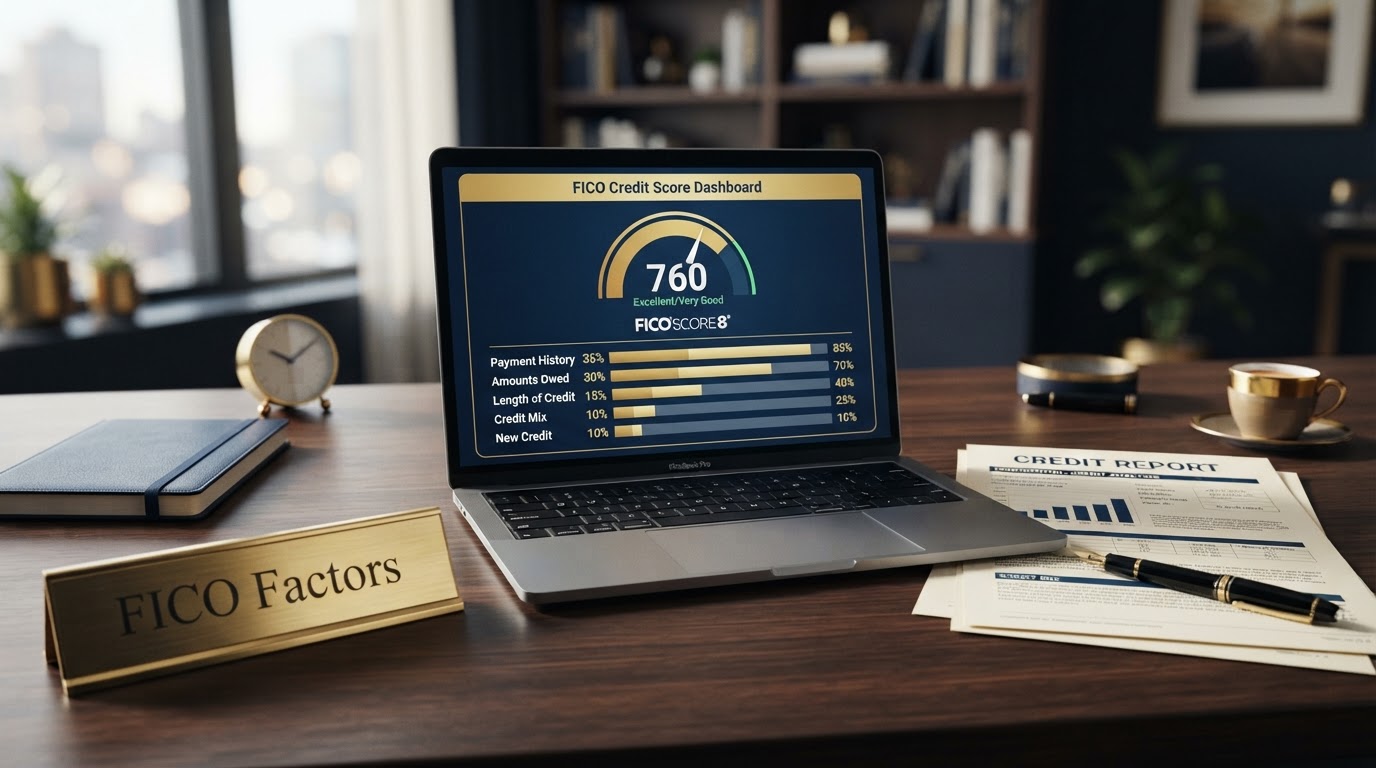
According to myFICO and Experian, the data in your credit report is grouped into five categories: payment history (35%), amounts owed (30%), length of credit history (15%), new credit (10%), and credit mix (10%). Those percentages are not arbitrary — they reflect decades of statistical analysis of what actually predicts repayment risk. 'Think of your score as a pie,' says Ashley Boswell. 'Payment history and amounts owed together are 65% of that pie. If you only focus on two things, focus on those two.'
Factor 1: Payment History (35%) — The Heavyweight
Payment history is the single most influential factor in your FICO Score, and for obvious reasons: the first thing any lender wants to know is whether you have paid past credit accounts on time. According to Experian, just one payment made 30 days late or more can do significant harm to your scores, and the negative impact becomes more severe the further behind you fall. An account sent to collections, a foreclosure, or a bankruptcy can have even deeper, longer-lasting consequences. 'Payment history is the factor you cannot fast-talk your way around,' notes Damon Boswell. 'A single missed payment can haunt you for years.' The key move is simple to say and hard to do: make every payment on time, every month. Set up autopay or enable text alerts for due dates. If you anticipate struggling, contact your creditors before you miss the payment — not after.
Factor 2: Amounts Owed (30%) — The Lever You Control
Amounts owed is the second-largest factor, and it is where your credit utilization ratio lives. As we covered in our utilization deep dive, this category measures how much of your available revolving credit you are using. According to Experian, those with the highest credit scores tend to have utilization ratios below 10%, but the lower the better — and you should broadly keep utilization below 30% to avoid a substantial negative impact. 'This is the factor people underestimate the most,' says Ashley Boswell. 'You can change your utilization in a single billing cycle. You cannot change your payment history that fast.' The key moves: pay down existing balances, request credit limit increases, keep old accounts open, and pay before your statement closing date so a low balance gets reported.
Factor 3: Length of Credit History (15%) — The Patience Factor
Length of credit history measures how long you have been using credit. The FICO Score evaluates the age of your oldest account, the age of your newest account, and the average age of all your accounts. In general, a longer credit history is positive for your scores. 'This is the factor that frustrates new credit builders the most,' notes Damon Boswell. 'You cannot buy time. You can only start the clock and let it run.' The key move here is counterintuitive: keep old accounts open even if you rarely use them. Closing an old card does not immediately erase its age from your report — accounts closed in good standing can remain on your report for up to 10 years — but it does remove that card's limit from your utilization calculation, which can hurt you in the amounts-owed category. 'We tell clients to put a small recurring charge on an old card and pay it off automatically,' Ashley Boswell advises. 'It keeps the account active and working for you.'
Factor 4: Credit Mix (10%) — Variety Helps
Credit mix considers your mix of credit cards, retail accounts, installment loans, finance company accounts, and mortgage loans. The scoring models reward borrowers who can successfully manage different types of credit — a blend of revolving accounts (like credit cards) and installment loans (like auto loans, student loans, or mortgages). 'Credit mix is a small factor, but it is the one that rewards a well-rounded financial life,' explains Damon Boswell. 'It tells the model you can handle more than just one kind of debt.' The key move: do not open a new type of credit just to improve your mix. Apply for credit only when you genuinely need it. Your mix will improve naturally as you use the types of credit your life requires — a card, then maybe a car loan, then someday a mortgage.
Factor 5: New Credit (10%) — Don't Apply in Bunches
New credit measures how many recent inquiries and new accounts you have. Research shows that opening several credit accounts in a short amount of time represents a greater risk, especially for people who do not have a long credit history. According to Experian, a hard inquiry may decrease your score by less than five points, and if you keep up with your bills, your score typically rebounds within a few months. 'The danger isn't one inquiry — it's a burst of them,' warns Ashley Boswell. 'If you apply for five cards in a month, the model reads desperation.' One important nuance: rate shopping for installment loans like mortgages, auto loans, and student loans is treated differently. The scoring models lump together hard inquiries on the same type of loan made within a short window (about 14 days to be safe) and count them as a single inquiry. Credit card applications do not get this treatment — each one counts separately.
How the Factors Work Together
No single factor operates in isolation. A perfect payment history means little if your utilization is maxed out. A long credit history loses value if you recently opened five new accounts. 'The score is a holistic picture,' explains Damon Boswell. 'You can't game one factor and ignore the rest. The strongest profiles are balanced across all five.' It is also worth noting that the importance of each category varies by person. myFICO is clear that scores for people who have not been using credit long are calculated differently than those with a longer credit history — so a new credit user is judged more heavily on recent behavior than someone with decades of history.
How Credit Repair and Building Map to the Five Factors
At Blueprint Business Advisors, Damon Boswell and Ashley Boswell do not treat the five factors as abstract theory — they are the framework behind every strategy we deploy. We dispute inaccurate, outdated, or unverifiable information on your credit reports with all three bureaus — Experian, Equifax, and TransUnion — which directly protects your payment history and amounts owed categories from errors dragging them down. Alongside disputes, we guide clients through secured card strategies, credit-builder loans, authorized user placements, and credit-readiness planning to actively build positive history across multiple factors at once. 'Repair cleans up the negatives; building adds the positives,' says Ashley Boswell. 'Together, they move every factor in the right direction.' Results vary, and no specific score increase is guaranteed — but understanding the five factors is the difference between guessing and strategizing.
The Common Mistakes That Hurt Multiple Factors at Once
Some mistakes are costly because they damage more than one factor simultaneously. Closing an old card hurts both length of credit history and amounts owed (by removing its limit from utilization). Missing a payment damages payment history and, if it leads to a higher balance, can worsen amounts owed. Applying for several cards at once hurts new credit and can lower your average account age. 'The worst mistakes are the ones that ripple,' notes Damon Boswell. 'One impulsive decision can touch three factors at once.'
How Blueprint Business Advisors Helps
Damon Boswell and Ashley Boswell review your real credit reports from all three bureaus, identify which of the five factors are hurting your score most, and build a personalized roadmap to strengthen each one. We help you understand utilization, payment timing, account age, credit mix, and inquiry management so every financial decision works with the scoring model instead of against it. We are not a lender, and we do not guarantee any specific score increase — but we give you the exact framework the scoring models are built on. 'Our goal is to help you understand and prepare for the process,' says Ashley Boswell. 'Once you know the five factors, you stop being at the mercy of the score.'
Start With a Free Consultation
If you have been trying to improve your credit without understanding what actually moves the number, it is time to get the full picture. Book a free, no-pressure consultation with Damon Boswell and Ashley Boswell at Blueprint Business Advisors. We will review your credit reports, map your profile across all five FICO factors, and build a personalized roadmap to repair, rebuild, and optimize your score. The five factors are not a secret — but most people never learn them. Let us show you how to use them.
Important Disclaimer
Blueprint Business Advisors is not a lender. We assist with preparation and placement only. All approval decisions, rates, amounts and terms are determined by third-party lenders and creditors. We dispute inaccurate, outdated, or unverifiable information on credit reports; we do not guarantee the removal of any specific item, any particular credit-score increase, or any specific outcome. Credit scoring models and reporting practices are controlled by the credit bureaus and scoring companies, including FICO. The factor weightings cited are based on publicly available information from myFICO and Experian and are educational, not a guarantee of individual results.

