
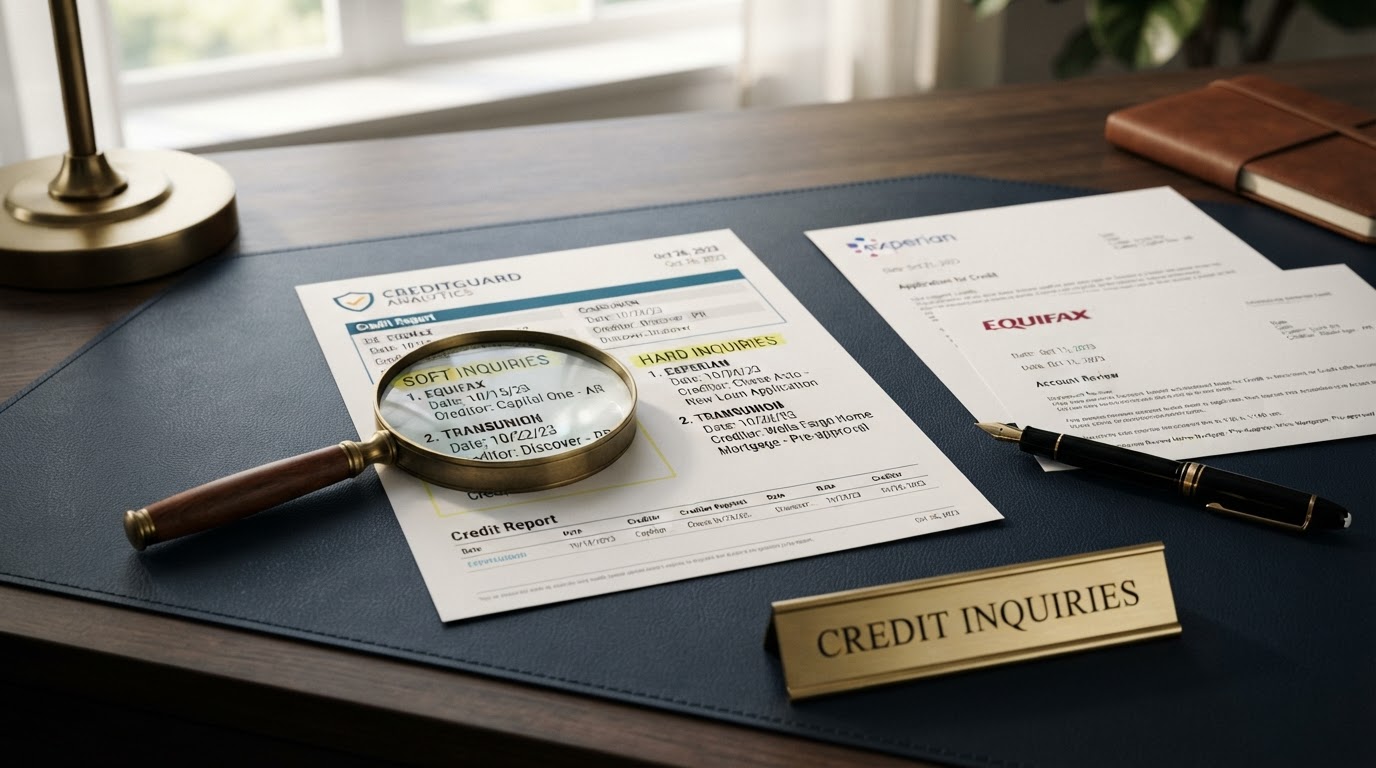
One of the most common questions Damon Boswell and Ashley Boswell hear is whether checking your credit — or letting a lender check it — will hurt your score. The honest answer is that it depends entirely on the type of inquiry. Not every credit check is the same, and understanding the difference between a hard inquiry and a soft inquiry can save you from unnecessary point drops right before a major application. Here is an honest, web-researched look at how hard and soft inquiries actually work in 2026, how much they affect your FICO Score, and how to time them around funding.
What Is a Credit Inquiry?
A credit inquiry is a record of someone accessing your credit report. There are two kinds: hard inquiries and soft inquiries. The distinction matters because only one of them can affect your score, and the rules around when and how are more nuanced than most people think. 'A credit inquiry is a footprint,' explains Damon Boswell. 'Every time someone looks at your file, a record is left behind. The question is whether that footprint weighs anything in the scoring model — and only hard inquiries do.'
What Is a Soft Inquiry?
A soft inquiry happens when a person or company checks your credit as part of a background check, a pre-approval, or when you check your own credit. According to Experian, a soft inquiry occurs when a person or company checks your credit as part of a background check, or when a lender checks your credit to pre-approve you for an offer. Critically, soft inquiries do not affect your credit scores, and they are not visible to lenders when you apply for credit — only you can see them on your report. 'Checking your own credit is one of the best habits a borrower can build,' says Ashley Boswell. 'It costs you nothing on your score, and it keeps you informed. The fear that monitoring your own credit will hurt it is a myth we correct constantly.'
What Is a Hard Inquiry?
A hard inquiry happens when a lender pulls your credit to make a lending decision — when you apply for a credit card, a mortgage, an auto loan, a personal loan, or a business line of credit. Hard inquiries require your consent, and they do affect your credit score. According to myFICO, a hard inquiry can lower your credit score, on average, five to ten points. According to Experian and FICO, a hard inquiry from a lender will typically decrease your credit score by five points or less, and if you have a strong credit history you may drop even less than that. 'The impact is real but small, and it is temporary,' notes Damon Boswell. 'A single hard pull is not going to wreck a good score. The danger is when hard pulls start stacking up.'
How Long Do Hard Inquiries Stay on Your Report?
Hard inquiries typically remain on your credit report for up to two years. However, FICO Scores only consider inquiries from the last 12 months — so an inquiry older than a year no longer factors into your score even though it still appears on your report. According to Credit Karma, the impact on your credit scores usually decreases or disappears before the inquiry drops off your credit reports. 'After twelve months, a hard inquiry stops counting,' explains Ashley Boswell. 'That is the number to remember. The two-year visibility is cosmetic; the one-year scoring window is what actually matters.'
The Rate-Shopping Window: Counting Multiple Inquiries as One
This is the rule that protects borrowers who shop around. According to myFICO, for recent versions of the FICO Score, numerous hard inquiries of the same type — student, auto, or mortgage loans — within a 45-day window are counted as a single inquiry. For older versions of the FICO Score, that rate-shopping window is 14 days. This means if you apply with five different mortgage lenders within 45 days, the scoring models recognize that as rate shopping rather than five separate applications, and it counts as a single inquiry. 'The rate-shopping window is the borrower's friend,' says Damon Boswell. 'But it only protects you for the same type of loan in the same window. A mortgage pull, an auto pull, and a credit card pull in the same month are three separate inquiries.' According to Credit Karma, some FICO scoring models also provide a grace period, often 30 days, before certain loan inquiries are reflected in your FICO credit scores.
Why Hard Inquiries Affect Your Score at All
New credit activity accounts for roughly 10% of your FICO Score. The scoring models interpret a recent hard inquiry as a signal that you may be taking on new debt, which statistically correlates with higher risk. 'The models are predictive, not punitive,' explains Ashley Boswell. 'They are not punishing you for applying. They are saying that someone applying for several new accounts in a short window is, statistically, a slightly higher risk. The point drop reflects that statistical signal, not a judgment.' This is also why a single inquiry barely moves a strong score — the rest of the file provides enough positive signal to outweigh it.
How Many Hard Inquiries Is Too Many?
According to Credit Karma, in general, one or two hard inquiries on your credit reports could lower your scores by a few points but is unlikely to have a significant impact. Having many hard inquiries within a short time frame, however, will likely have a greater impact on your scores. 'There is no magic number that automatically disqualifies you,' notes Damon Boswell. 'But once you cross into four, five, six inquiries in a short window, lenders start reading it as financial distress — someone scrambling for credit. That reading matters as much as the point drop.' This is exactly why a scattered, unfocused application strategy is one of the most common ways borrowers quietly damage their own files.
How This Connects to Our Funding Work
At Blueprint Business Advisors, the inquiry question comes up constantly because our funding concierge approach involves helping clients apply for financing. Before we help a client submit an application, Damon Boswell and Ashley Boswell review whether a hard pull is even necessary at that stage, whether the client is likely to qualify so the pull is not wasted, and whether the timing fits the rate-shopping window. 'A poorly timed hard pull is a small, preventable mistake that compounds,' explains Damon Boswell. 'We help clients sequence their applications so that the pulls that do happen are intentional, well-timed, and clustered inside a rate-shopping window where they count as one.' We help qualified clients pursue appropriate personal and business funding opportunities. Funding amounts vary according to creditworthiness, income, revenue, lender criteria, and repayment ability. No minimum approval amount is guaranteed.
How This Connects to Credit Repair and Building
Inquiries sit at the intersection of credit repair and credit building. If inaccurate inquiries appear on your report — a pull you did not authorize, or a duplicate that should have been counted as one — those can be disputed. At Blueprint Business Advisors, we dispute inaccurate, outdated, or unverifiable information with the bureaus; we do not guarantee the removal of any specific item, any particular credit-score increase, or any specific outcome. On the building side, we help clients understand that spacing out applications and avoiding unnecessary pulls is itself a form of credit management. 'You cannot build a strong file while simultaneously punching holes in it with careless applications,' says Ashley Boswell. 'Discipline around inquiries is part of the strategy, not a separate concern.'
Practical Rules to Protect Your Score
Damon Boswell and Ashley Boswell give clients a simple set of rules around inquiries. First, check your own credit freely and often — it is a soft pull and costs you nothing. Second, do not apply for new credit unless you have a real need and a reasonable chance of approval — a denied application still costs you the hard pull. Third, when rate shopping for a mortgage, auto loan, or student loan, cluster your applications within the 45-day window so they count as a single inquiry. Fourth, do not mix loan types in the same shopping window — a mortgage pull and a credit card pull are separate inquiries. Fifth, remember that pre-qualification offers you receive in the mail are soft pulls and do not affect your score. 'These five rules cover almost every inquiry situation a borrower will face,' notes Damon Boswell.
A Note on Disputing Inquiries
Some credit repair marketing suggests you can simply dispute every hard inquiry to have it removed. That is not accurate. Legitimate hard inquiries that you authorized by applying for credit are accurate information and are not removed through dispute. Inquiries that can be disputed and potentially removed include those you did not authorize, those resulting from identity theft, and duplicates that should have been grouped as a single inquiry. 'We never tell a client we can remove a legitimate inquiry,' emphasizes Ashley Boswell. 'Promising to delete inquiries you authorized is exactly the kind of guarantee we will not make. We dispute what is inaccurate — and we are honest about what is not.'
The Timing Strategy Before a Major Application
If you are planning a mortgage or major business funding application, Damon Boswell and Ashley Boswell help you build a timeline. Stop applying for new credit several months in advance, let any recent inquiries age past the 12-month scoring window where possible, and avoid any unnecessary pulls in the run-up to the application. 'A clean inquiry profile heading into a major application removes one more reason for a lender to hesitate,' explains Damon Boswell. 'You control the timing, and timing is leverage.'
How Blueprint Business Advisors Helps
Damon Boswell and Ashley Boswell review your real credit reports from all three bureaus — Experian, Equifax, and TransUnion — and help you understand your inquiry profile, which inquiries are scoring against you, which may be inaccurate and disputable, and how to time future applications to protect your score. As part of our funding work, we help sequence applications so hard pulls are intentional and clustered inside rate-shopping windows. We are not a lender, and we do not guarantee the removal of any specific item, any particular credit-score increase, or any specific outcome. 'Our goal is to help you build and protect a credit profile that is real and verifiable,' says Ashley Boswell. 'That includes being smart about who looks at it and when.'
Start With a Free Consultation
If you are worried about how many inquiries are on your report, or if you are preparing for a major application and want to make sure your inquiry profile is clean, it is time to get a real roadmap. Book a free, no-pressure consultation with Damon Boswell and Ashley Boswell at Blueprint Business Advisors. We will review your credit reports, map your inquiry profile across all three bureaus, and build a plan that protects your score while positioning you for the funding you actually need.
Important Disclaimer
Blueprint Business Advisors is not a lender, a credit bureau, or a credit-scoring company. We assist with preparation, education, and placement only. We dispute inaccurate, outdated, or unverifiable information on credit reports; we do not guarantee the removal of any specific item, any particular credit-score increase, or any specific outcome. Credit scoring models and reporting practices are controlled by the credit bureaus and scoring companies, including FICO. The inquiry information cited is based on publicly available guidance from Experian, myFICO, and Credit Karma and is educational, not legal advice. Legitimate hard inquiries that you authorized are accurate information and are not removed through dispute. Consult a qualified consumer-credit attorney for legal questions specific to your situation.

