
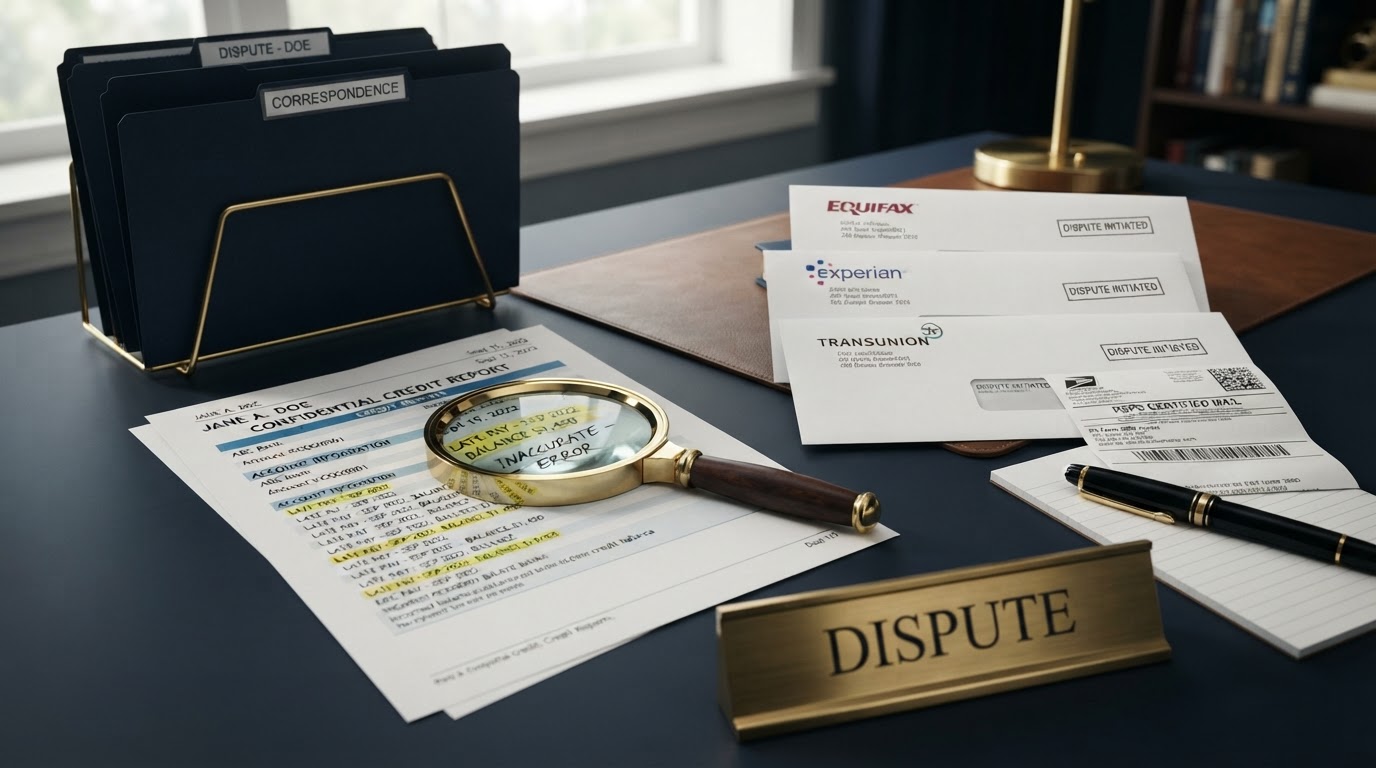
Damon Boswell tells every client the same thing on day one: you have the legal right to dispute inaccurate information on your credit report yourself, for free, without anyone's help. The Fair Credit Reporting Act gives you that right, and the Consumer Financial Protection Bureau and the Federal Trade Commission both publish step-by-step guidance for doing it. You do not need a company to dispute for you — but you do need to understand the process, because doing it wrong wastes time and gets you nowhere. Here is an honest, web-researched, step-by-step guide to disputing a credit report error yourself under the FCRA in 2026, and how Damon Boswell and the team at Blueprint Business Advisors help clients who want professional support.
Your Right Under the Fair Credit Reporting Act
The Fair Credit Reporting Act is the federal law that gives you the right to dispute inaccurate, outdated, or unverifiable information on your credit reports. According to the CFPB, if you identify an error on your credit report, you should start by disputing that information with the credit reporting company — Experian, Equifax, and/or TransUnion. 'The FCRA is the consumer's most powerful tool,' explains Damon Boswell. 'It is the law that says the bureaus have to listen when you tell them something is wrong. You can use it on your own, with or without assistance. That is not a disclaimer — that is the truth, and we tell every client.'
Step 1: Get All Three Reports
Before you dispute anything, you need to see what is actually on your reports from all three bureaus. Because creditors are not required to report to all three bureaus, your Experian, Equifax, and TransUnion reports can look meaningfully different. An item may appear on one report and not another, and an error may exist on only one. 'If you only look at one report, you are only seeing one-third of the picture,' says Damon Boswell. 'You can get all three for free at AnnualCreditReport.com. Pull them, print them, and read every line.'
Step 2: Identify the Errors
Not everything negative is an error. Accurate negative items can remain on your report for their full reporting period — generally seven years for most negatives. What you are looking for is inaccurate, outdated, or unverifiable information. According to the CFPB, you should explain in writing what you think is wrong, why, and include copies of documents that support your dispute. 'The errors we see most often fall into five categories,' notes Damon Boswell. 'Accounts that do not belong to you, incorrect account statuses, outdated information that has passed its reporting time limit, incorrect balances or dates, and duplicate accounts. Circle each one. You are building a case, not filing a complaint.'
Step 3: Gather Your Evidence
According to Credit Karma, the first step to disputing an error is to gather your evidence — bank statements, payment confirmations, or any supporting documentation you can find. Save these files as PDFs or take screenshots so you can upload them with your claim. 'Evidence is what separates a successful dispute from a denied one,' explains Damon Boswell. 'A dispute that says this is wrong without proof is easy for the bureau to dismiss. A dispute that says this is wrong, here is the bank statement showing the payment was made on time, is much harder to ignore.'
Step 4: Write the Dispute Letter
According to the CFPB and the FTC, your dispute letter should include your complete name and address, each mistake that you want fixed and why, copies (not originals) of documents that support your request, a copy of your report with the disputed items circled or highlighted, and a request that the information be removed or corrected. The CFPB publishes a sample letter you can use as a template. 'Be specific and be clear,' advises Damon Boswell. 'State the account number, state the error, state why it is wrong, and state what you want them to do. Vague disputes get vague responses. Specific disputes get investigations.'
Step 5: Submit the Dispute — Online, by Mail, or by Phone
You can dispute with each credit bureau online, by mail, or by phone. According to the CFPB, you can contact Equifax online at equifax.com, by phone, or by mail; Experian online at experian.com/disputes or by phone; and TransUnion online at dispute.transunion.com or by mail or phone. If you mail your dispute, the CFPB recommends sending it by certified mail and asking for a return receipt so you have a record that your letter was received. 'Certified mail is not paranoia — it is proof,' says Damon Boswell. 'If the bureau claims they never received your dispute, the certified receipt is your evidence that they did. Keep copies of everything you send.'
Step 6: The 30-Day Investigation Window
Once the credit bureau receives your dispute, the clock starts. According to the FTC and the CFPB, the credit bureau has 30 days to investigate your dispute. There are some cases where they may take up to 45 days — for example, if you file a dispute after receiving your free annual credit report. According to Equifax, you will get the results of the dispute investigation within 30 days. 'The 30-day window is the heart of the FCRA process,' explains Damon Boswell. 'During that window, the bureau must forward your dispute to the furnisher — the company that provided the information — and the furnisher must investigate and respond. If the furnisher cannot verify the information, it must be removed or corrected.'
Step 7: The Furnisher Investigation
Credit reporting companies gather information from other companies called furnishers — your bank, your landlord, your credit card company. According to the CFPB, furnishers generally must investigate and respond to your dispute within 30 days of when they receive it. If the investigation shows the furnisher provided wrong information, or the information cannot be verified, the furnisher must update or remove the information and notify all the credit reporting companies. 'The furnisher is the source,' notes Damon Boswell. 'If the furnisher cannot prove the information is accurate, the bureau has to remove it. That is why disputes work — the burden of verification is on the furnisher, not on you.'
Step 8: The Results
Once the investigation is complete, the bureau has five business days to notify you of the results. If the item is corrected or removed, you will receive an updated copy of your report. If the bureau determines the information is accurate, the item stays. 'A denial is not the end,' says Damon Boswell. 'It means the furnisher verified the information this time. You can dispute again — but you need to add new information or evidence, not just repeat the same dispute. A duplicate dispute with no new evidence will get the same result.'
Step 9: What to Do If the Dispute Is Denied
According to the CFPB, if the furnisher determines the information is accurate, you can contact the credit reporting companies again and ask them to include a statement explaining the dispute in your credit reports — a consumer statement that is added to your file and provided to anyone who requests your credit report in the future. You can also submit a complaint with the CFPB. 'A consumer statement does not change your score, but it gives context,' explains Damon Boswell. 'And a CFPB complaint creates a record that the bureau has to respond to. Sometimes a complaint is what moves a stalled dispute forward.'
The Frivolous Dispute Trap
According to the CFPB, a credit reporting company is not required to investigate disputes that it reasonably determines are frivolous or irrelevant — such as disputes that do not contain enough information to investigate. The company must send you a notice explaining that it has decided the dispute is frivolous and why, within five business days. 'This is the trap people fall into when they dispute everything at once with no evidence,' warns Damon Boswell. 'If you fire off dozens of disputes with no supporting information, the bureau can flag them as frivolous and stop investigating. Specific, evidenced disputes are the way. Shotgun disputes get you ignored.'
You Can Also Dispute With the Furnisher Directly
According to the CFPB, you can also dispute the information directly with the furnisher — the company that provided it to the credit reporting companies. Send disputes to furnishers in writing, using certified mail, to the furnisher's address included on your consumer report or to an address specified by the furnisher for receiving credit reporting disputes. 'Disputing with the furnisher directly is an underused path,' notes Damon Boswell. 'Sometimes the furnisher corrects or removes the information faster than the bureau does. You can do both — dispute with the bureau and the furnisher at the same time.'
How This Connects to Credit Building
Disputing is only half the strategy. Alongside disputes, Damon Boswell guides clients through secured card strategies, credit-builder loans, authorized user placements, and credit-readiness planning to actively build a positive credit profile. 'Repair removes the negatives that should not be there; building adds the positives that should,' says Damon Boswell. 'A file that is only clean but empty still produces a low score, because there is nothing positive to offset. We help you do both sides of the work.' Results vary, and no specific score increase is guaranteed.
When Professional Help Makes Sense
You can dispute on your own — that is your right under the FCRA. But Damon Boswell is honest about why some clients choose professional support. The process is time-consuming, the follow-up is relentless, and managing disputes across all three bureaus simultaneously requires organization. 'We do not have special powers the consumer does not have,' explains Damon Boswell. 'What we have is a system, experience, and the time to follow up relentlessly. If you have the time and organization to do it yourself, you should. If you do not, that is where we come in. We handle all the paperwork, follow-ups, and negotiations with Experian, Equifax, and TransUnion.'
How Blueprint Business Advisors Helps
Damon Boswell reviews your real credit reports from all three bureaus, identifies which items are accurate and aging and which are inaccurate, outdated, or unverifiable and disputable, and handles the dispute process — the letters, the evidence, the certified mail, the follow-ups, and the negotiations with all three bureaus. We pair the dispute work with active credit building so your profile strengthens while the disputes process. We are not a credit bureau or a credit-scoring company, and we do not guarantee the removal of any specific item, any particular credit-score increase, or any specific outcome. 'Our goal is an accurate, complete, and strong credit profile,' says Damon Boswell. 'When the report is right, the score takes care of itself.'
Start With a Free Consultation
If you have errors on your credit report and you want to understand the process — whether you plan to dispute yourself or want professional support — it is time to get a real roadmap. Book a free, no-pressure consultation with Damon Boswell at Blueprint Business Advisors. We will pull your reports from all three bureaus, read them together, and show you exactly what is helping you, what is hurting you, what should not be there, and what your options are. The FCRA gives you the right. We help you use it.
Important Disclaimer
Blueprint Business Advisors is not a lender, a credit bureau, or a credit-scoring company. We assist with preparation, education, and placement only. We dispute inaccurate, outdated, or unverifiable information on credit reports; we do not guarantee the removal of any specific item, any particular credit-score increase, or any specific outcome. Under the Fair Credit Reporting Act, you have the right to dispute inaccurate information on your own, with or without assistance. Credit reporting practices and scoring models are controlled by the credit bureaus and scoring companies, including FICO. The dispute process cited is based on publicly available guidance from the Consumer Financial Protection Bureau, the Federal Trade Commission, Equifax, and Credit Karma and is educational, not legal advice.

