
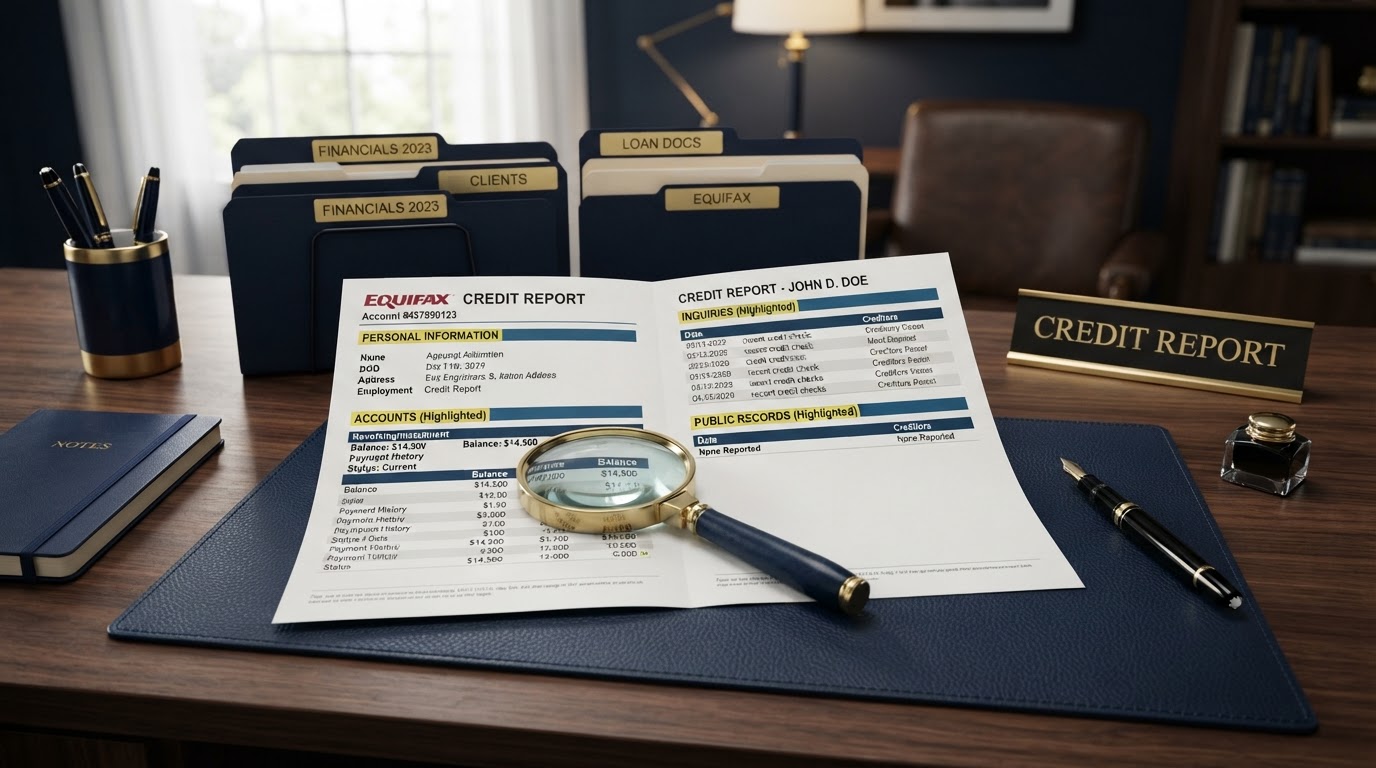
You cannot fix what you cannot read. Yet most people have never actually looked at their full credit report — they have only seen the three-digit score on an app and assumed that number tells the whole story. It does not. Your credit report is the source document behind that score, and it is packed with details that can either help you or quietly hold you back. At Blueprint Business Advisors, Damon Boswell and Ashley Boswell sit down with every new client and read their report together, line by line, because the errors that cost people the most are almost always hiding in plain sight. Here is an honest, web-researched, section-by-section guide to reading your credit report in 2026.
First: Your Credit Report Is Not Your Credit Score
This is the most common confusion we clear up. Your credit report and your credit score are two different things. According to USAGov, your credit report shows your personal financial information, including your bill payment history, loans, current debt, and bankruptcy history — and in most cases, your credit report will not include your credit score. The score is a number calculated from the information in the report. The report is the raw data; the score is the grade derived from it. 'If your score is low, the reason lives inside the report,' explains Damon Boswell. 'You cannot raise the score directly. You fix the report, and the score follows.'
How to Get All Three Reports for Free
There are three major credit bureaus — Experian, Equifax, and TransUnion — and they do not always show the same information, because not every creditor reports to all three. According to Equifax, your credit report may not contain all your credit accounts, and it is possible that an account is not reported to a given bureau by one of your creditors. That is why you need all three. The only federally authorized source for free reports is AnnualCreditReport.com, where you can request your reports from Equifax, Experian, and TransUnion. According to AnnualCreditReport.com, checking your own credit report is a soft inquiry, which is only visible to you and does not influence the calculations used by lenders or creditors. 'Pulling your own report never hurts your score,' notes Ashley Boswell. 'That fear keeps people in the dark, and the dark is expensive.'
Section 1: Personal Information
Every credit report opens with your identifying details. According to TransUnion, the personal information section lists your names, addresses, phone numbers, date of birth, Social Security number, and employer information. According to Equifax, this section is not used to calculate your credit scores — but it is still important, because lenders use it to verify your identity, and errors here can signal bigger problems. 'The personal information section is where we first hunt for identity theft,' says Damon Boswell. 'If you see an address you never lived at or an employer you never worked for, that is a red flag that someone may be using your identity to open accounts.' Common errors include misspelled names, outdated addresses, and mixed files where another person's information has been merged into yours — a serious problem that happens more often than people realize, especially with common names.
Section 2: Account Information (Credit Accounts)
This is the heart of your report. The accounts section lists your credit accounts and key details about them, including revolving credit accounts and installment loans such as credit cards, personal loans, auto loans, and mortgages. According to Experian, each account entry typically includes the account name, a truncated account number, the account status, the date opened, the account type, and the credit limit or original balance. 'This section is where most of the damage — and most of the opportunity — lives,' explains Ashley Boswell. 'Every account here is either helping you or hurting you, and you need to know which is which.'
Understanding Account Status Codes
Account status tells you the current state of the account as reported by the creditor. According to Experian, common statuses include open, paid, closed, refinanced, transferred, and foreclosed, and past-due amounts can be reported as 30, 60, 90, 120, or 150 days late. 'The status code is the single most important field on each account,' notes Damon Boswell. 'A status that says Open and Current is doing work for you. A status that says Charge-Off or 90 days late is doing damage every single month it sits there.'
What a Charge-Off Actually Means
A charge-off is one of the most damaging entries on a credit report, and it is widely misunderstood. According to TransUnion, a charge-off appears in the Pay Status of the account's information section when a creditor has given up trying to collect the debt, and if the charge-off has been paid, the status will indicate something like Account paid in full; was a charge-off. According to the National Consumer Law Center, when a credit card account is more than 180 days past due, it must generally be charged off, meaning the debt is no longer carried as an asset of value by the creditor. 'A charge-off does not mean the debt disappeared,' warns Ashley Boswell. 'You still owe it, it can still be sent to collections, and it stays on your report for seven years. But a charge-off that is inaccurately reported — wrong date, wrong amount, or not actually yours — is exactly the kind of item we dispute.'
How Long Negative Information Stays
Understanding the reporting time limits is essential, because outdated information that should have fallen off is one of the most common — and most fixable — errors on a credit report. According to TransUnion, accounts closed in good standing remain for 10 years, missed payments remain for 7 years, collections remain for 7 years, Chapter 7 bankruptcies remain for 10 years, and Chapter 13 bankruptcies remain for 7 years. According to Experian, a charge-off remains on your credit report for seven years. 'If a collection from 2015 is still showing in 2026, that is a dispute waiting to happen,' says Damon Boswell. 'The law sets the clock, and when the clock runs out, the item has to go.'
Section 3: Collections
Collections are accounts that have been sent to collection agencies. According to TransUnion, the collections section lists accounts sent to collection agencies, and according to Experian, a collection entry includes the account name, a truncated account number, the date the collection was opened, the account type, and the original creditor. 'Collections are where people feel the most shame, and where we do some of our most important work,' notes Ashley Boswell. 'A collection that is not yours, that is reported past the seven-year limit, or that shows a wrong balance is inaccurate information — and inaccurate information is what the dispute process exists to correct.' It is also worth knowing that the rules around certain collections have changed: according to Equifax, effective July 1, 2022, medical debt sent to a collection agency that you have paid off will no longer appear on any credit report.
Section 4: Inquiries
Inquiries are records of who accessed your credit report, and they come in two types. According to Equifax, soft inquiries happen when you check your own credit reports, when companies extend pre-approved offers, or when current creditors conduct account reviews — and soft inquiries do not impact credit scores. Hard inquiries occur when companies or lenders review your credit reports because you applied for credit or a service, such as a new loan, credit card, or mobile phone contract, and hard inquiries remain on your credit reports for up to two years and may impact credit scores. According to Experian, hard inquiries are maintained for two years from the date of request, and inquiries are not currently disputable online — if you believe an inquiry is the result of identity theft, it can be disputed by phone. 'The inquiry section is where we look for fraud,' explains Damon Boswell. 'A hard pull from a lender you never applied with is a sign someone is using your identity. We help clients spot that early, before it multiplies.'
Section 5: Public Records
The public records section contains information obtained from courts. According to Experian, bankruptcies are the only public record that will appear on your credit history, and the public records section may include items obtained through third-party vendors. According to TransUnion, when reviewing public records you should check that the bankruptcy type is correctly listed, verify the filing date because it determines how long the record remains, and ensure the public record actually belongs to you and not someone with a similar name. 'Public records are the heaviest items on a report, and they are also the most prone to errors of identity,' notes Ashley Boswell. 'A bankruptcy that is not yours, or one that is past its reporting window, can be disputed. We never promise removal — but we always verify accuracy.'
Section 6: Consumer Statements
Some reports include a consumer statement section — a note you have added to your own file. According to TransUnion, the consumer statement section contains notes you have added to your file, and according to Experian, personal statements can include consumer-initiated statements, security freezes, fraud alerts, credit locks, or account-specific statements of explanation or dispute. 'A consumer statement does not change your score, but it gives context,' explains Damon Boswell. 'If you have a legitimate dispute on an account, a statement of dispute tells any lender reading your report that you do not agree with how the account is being reported.'
Your Rights Under the FCRA
All of this is governed by the Fair Credit Reporting Act (FCRA), the federal law that gives you the right to see your report, the right to dispute inaccurate information, and the right to have errors corrected. According to TransUnion, the summary of rights section outlines your rights under the FCRA. Under the FCRA, if you dispute an item, the bureau generally has 30 days to investigate it, and once the investigation is complete, the bureau has five business days to notify you of the results. 'The FCRA is the consumer's most powerful tool,' says Ashley Boswell. 'It is the law that says the bureaus have to listen when you tell them something is wrong. We use it every single day.'
How to Actually Spot the Errors
Reading the report is only half the job — the other half is knowing what to look for. Damon Boswell and Ashley Boswell train clients to scan for five categories of errors. First, accounts that do not belong to you, which can indicate mixed files or identity theft. Second, incorrect account statuses, such as an account showing as open when it is closed, or current when it is actually late. Third, outdated information that has passed its reporting time limit and should have fallen off. Fourth, incorrect balances or limits, which can distort your utilization ratio even when the account itself is legitimate. Fifth, duplicate accounts, where the same debt is reported more than once — sometimes once by the original creditor and again by a collection agency. 'These five categories cover the vast majority of the errors we find,' notes Damon Boswell. 'You do not need to be a credit expert to spot them — you need to read carefully and know what accurate looks like.'
Why All Three Reports Matter
Because creditors are not required to report to all three bureaus, your Experian, Equifax, and TransUnion reports can look meaningfully different. An account may appear on one report and not another, an error may exist on only one, and a collection may have fallen off two reports but linger on the third. 'We have seen clients with a 60-point difference between bureaus because of a single inaccurate account on one report,' says Ashley Boswell. 'If you only look at one report, you are only seeing one-third of the picture. You have to read all three.'
How This Connects to Our Credit Repair Service
Reading the report is the first step; disputing the inaccuracies is where our credit repair service begins. At Blueprint Business Advisors, Damon Boswell and Ashley Boswell dispute inaccurate, outdated, or unverifiable information directly with all three bureaus, including foreclosures, bankruptcies, judgments, late payments, public records, collections, repossessions, student loans, medical bills, charge-offs, child support items, evictions, tax liens, and short sales. We handle all the paperwork, follow-ups, and negotiations with Experian, Equifax, and TransUnion. But we are honest about what we can and cannot do: we advocate on your behalf and dispute inaccurate information, but we never guarantee specific items will be removed — results depend on each item and each bureau's response. 'We do not promise miracles,' emphasizes Damon Boswell. 'We promise a thorough, legal, relentless review of your file and a dispute process that follows the FCRA to the letter.'
How This Connects to Credit Building
Reading the report also reveals the building opportunities, not just the repair opportunities. A thin file — few accounts, short history — is a different problem than a damaged file, and it needs a different solution. Alongside disputes, Damon Boswell and Ashley Boswell guide clients through secured card strategies, credit-builder loans, authorized user placements, and credit-readiness planning to actively build a positive credit profile. 'Sometimes the report is clean but empty,' notes Ashley Boswell. 'A clean but empty file still produces a low score, because there is nothing positive to offset. Building is just as important as repairing.' Results vary, and no score increase is guaranteed.
How Blueprint Business Advisors Helps
Damon Boswell and Ashley Boswell review your real credit reports from all three bureaus, walk you through every section, identify the inaccuracies that are holding you back, and build a personalized dispute and building strategy. We handle the disputes, the follow-ups, and the negotiations with the bureaus so you can focus on your life while we focus on your file. We are not a credit bureau or a credit-scoring company, and we do not guarantee the removal of any specific item, any particular credit-score increase, or any specific outcome. 'Our goal is an accurate, complete, and strong credit profile,' says Damon Boswell. 'When the report is right, the score takes care of itself.'
Start With a Free Consultation
If you have never actually read your full credit report — or if you have, and you suspect there are errors quietly dragging down your score — it is time to get a real roadmap. Book a free, no-pressure consultation with Damon Boswell and Ashley Boswell at Blueprint Business Advisors. We will pull your reports, read them together section by section, and show you exactly what is helping you, what is hurting you, and what we can do about it.
Important Disclaimer
Blueprint Business Advisors is not a lender, a credit bureau, or a credit-scoring company. We assist with preparation, education, and placement only. We dispute inaccurate, outdated, or unverifiable information on credit reports; we do not guarantee the removal of any specific item, any particular credit-score increase, or any specific outcome. Credit reporting practices and scoring models are controlled by the credit bureaus and scoring companies, including FICO. The credit report information cited is based on publicly available guidance from TransUnion, Experian, Equifax, USAGov, AnnualCreditReport.com, and the National Consumer Law Center and is educational, not legal advice. Under the FCRA, you have the right to dispute inaccurate information on your own, with or without assistance. Consult a qualified consumer-credit attorney for legal questions specific to your situation.

