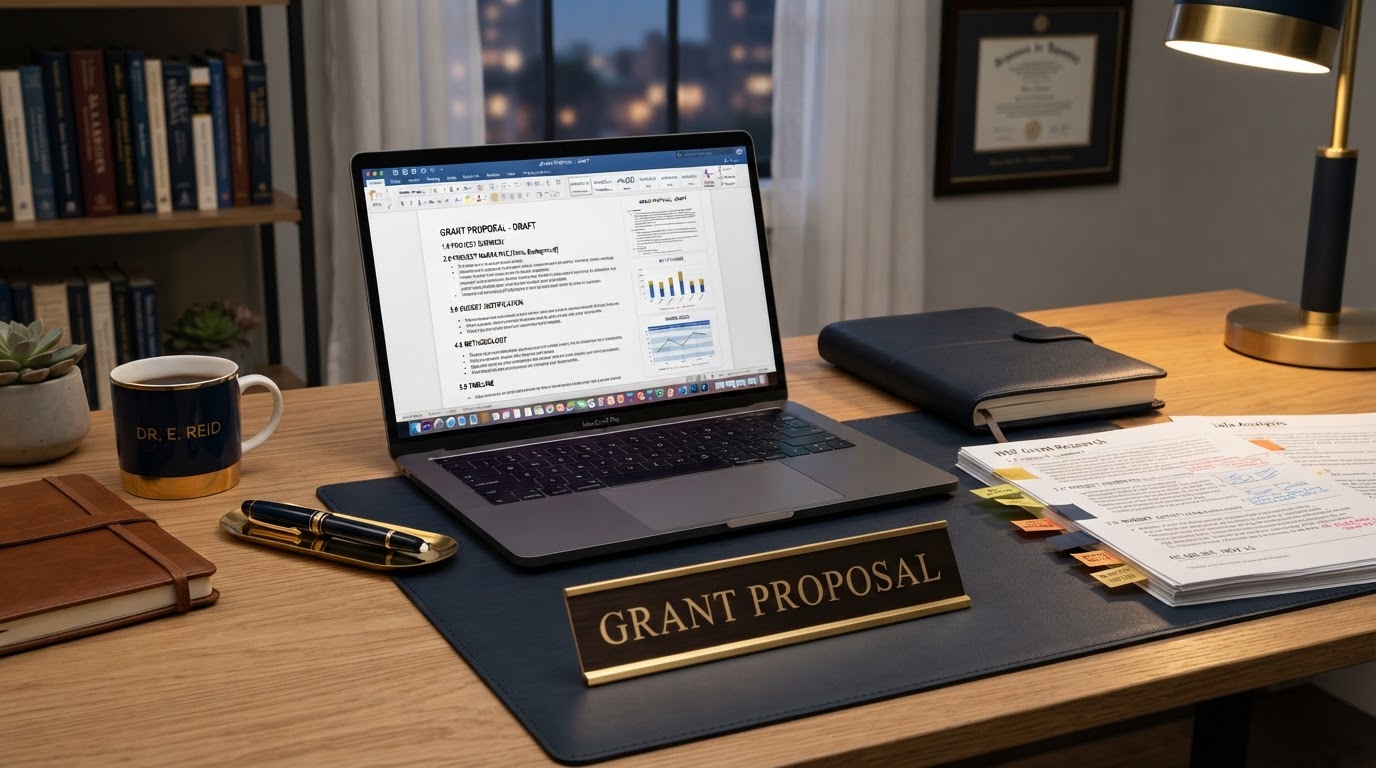
Securing a grant can be transformative for a nonprofit — but writing a winning grant proposal is one of the most misunderstood skills in the nonprofit world. Too many founders treat grants like a lottery ticket, firing off generic applications and hoping for the best. In reality, a strong proposal is a carefully constructed argument: it demonstrates a real need, presents a credible plan, and proves your organization can deliver. At Blueprint Business Advisors, Ashley Boswell and Damon Boswell help nonprofits research grant opportunities and write applications that funders actually take seriously. Here's an honest, web-researched, step-by-step guide to writing a winning grant proposal in 2026.
The Honest Truth About Grants First
Before we get to the craft of proposal writing, let's be clear about what grants are and aren't. Grants are limited, competitive awards given to organizations whose mission aligns with the funder's priorities. They are never guaranteed money, and there are no federal grants for simply starting a for-profit business. We research grant opportunities for which a client or organization may be eligible — including local, state, federal, and private foundation grants — and help write the applications. But we never describe grants as free personal money available to everyone. 'If someone promises you guaranteed grant funding, walk away,' Damon Boswell warns. 'Real grants require a real application, a real mission, and real eligibility.'
Step 1: Research the Funder Before You Write a Word
The single biggest mistake nonprofits make is writing a proposal before understanding the funder. Every grantmaker has a specific strategy — the types of organizations they fund, the issue areas they care about, the geographic regions they serve, and the size of grants they typically award. Before you apply, study the funder's website, review their past grants, and read their guidelines carefully. 'A brilliant proposal sent to the wrong funder is a guaranteed no,' says Ashley Boswell. 'Fit comes before craft. If your mission doesn't align with their priorities, no amount of good writing will save it.' Make sure you know the deadline, the eligibility requirements, and exactly what the funder asks for — and follow their guidelines to the letter.
Step 2: Write a Compelling Executive Summary
The executive summary is the first thing a reviewer reads, and for many, it determines whether they read the rest. According to grant-writing guidance from Candid, a strong executive summary should include the problem or need you're addressing, a brief description of the project including your goals and objectives, information about your organization and its experience addressing that need, and how much money you're requesting. 'Think of the executive summary as your proposal's elevator pitch,' explains Damon Boswell. 'It has to convey the need, the solution, your credibility, and the ask — all in a few paragraphs.' Write it last, after the rest of your proposal is solid, so it accurately reflects your strongest case.
Step 3: Build a Powerful Statement of Need
Your statement of need answers the most important question a funder has: why does this matter? This section should demonstrate, with data and evidence, the specific problem your project addresses. Use credible statistics, community assessments, and research — not just anecdotes. Be specific about the population you serve and the gap your project fills. 'Funders fund problems they can see clearly,' notes Ashley Boswell. 'If you can't quantify the need, the funder can't justify the award.' Avoid exaggeration and doom-and-gloom framing without a path forward; funders want to fund solutions, not just despair.
Step 4: Describe Your Project in Detail
Your project description should delve into the specific activities of your project and how they will benefit your target demographic. Include a detailed outline that explains exactly how, when, and by whom the project will be executed and completed. Define clear, measurable goals and objectives — not vague aspirations. Emphasize any collaborations and partnerships with other organizations, because partnerships boost your credibility and show you're not duplicating efforts. 'Funders want to see that you've thought through the execution,' says Damon Boswell. 'Who does what, when, and how do we know it worked? If you can't answer that, the proposal isn't ready.'
Step 5: Show How You'll Measure Success
Increasingly, funders want to see outcomes, not just activities. Define the metrics you'll use to evaluate whether your project succeeded. How will you track participation, behavior change, or community impact? What does success look like, and how will you report it? 'Outcome-driven writing is what separates funded proposals from the pile,' explains Ashley Boswell. 'Don't just tell the funder what you'll do — tell them how they'll know their money worked.' Be realistic; overpromising on outcomes you can't measure undermines your credibility.
Step 6: Build a Clear, Honest Budget
Your project budget should mirror the direct and indirect costs of the items outlined in your project description — staffing, rent, supplies, promotion, and the like. Detail the revenue sources you plan to use to fund the project, and be sure to explain how you will sustain the project beyond the specific grant you're seeking. Funders are wary of organizations that depend entirely on a single grant to survive. 'The budget tells the funder whether you actually understand what your project costs,' says Damon Boswell. 'A vague or mathematically inconsistent budget is a red flag. A clean, justified budget signals competence.'
Step 7: Demonstrate Organizational Capacity
Funders don't just fund ideas — they fund organizations they trust to execute. Show your track record: your history, your leadership, your board, your past successes, and your financial health. A strong, engaged board signals governance and accountability. 'Your organization's credibility is part of the proposal,' notes Ashley Boswell. 'A rubber-stamp board and no track record won't win competitive grants.' This is why, at Blueprint Business Advisors, we advise on structuring a board with the right mix of skills, networks, and diversity of perspective.
Step 8: Write Clearly, Edit Relentlessly
Always follow the funder's guidelines and keep your language clear and concise. Avoid jargon, acronyms, and dense academic prose. Start with an outline to organize your thoughts. Tap into the power of your colleagues' feedback, and revise and edit your proposal before submitting it. 'Clarity beats cleverness every time,' says Damon Boswell. 'The reviewer is reading dozens of these. Make yours easy to understand, easy to score, and easy to say yes to.' Focus on the funder's objectives and use your powers of persuasion to make them understand that your approach is in their best interest.
Step 9: Plan for Sustainability
Funders want to know what happens after their grant runs out. Show how your project will create lasting change, even after the funding ends. Will the project generate its own revenue? Will you pursue additional grants? Will outcomes be institutionalized? 'Sustainability is the question that sinks more proposals than people realize,' warns Ashley Boswell. 'If your project dies the day the grant ends, the funder sees a poor investment.'
How Blueprint Business Advisors Helps
Ashley Boswell and Damon Boswell handle the turnkey nonprofit setup — filing Articles of Incorporation, drafting bylaws, forming the board, and preparing IRS Form 1023 or 1023-EZ for 501(c)(3) status. We also help with initial fundraising strategy, identifying grant opportunities for which your organization may be eligible, and writing the applications. We research grant opportunities — including local, state, federal, and private foundation grants — and help position your organization to compete. But grants are limited, competitive, and never guaranteed. We are not the IRS, and approval of your 501(c)(3) status is determined by the IRS. 'Our job is to give your organization the strongest possible foundation and the clearest possible voice,' says Damon Boswell. 'The rest is up to the funder.'
Start With a Free Consultation
If you're ready to pursue grant funding the right way — with a registered nonprofit, a credible board, and proposals that funders respect — book a free, no-pressure consultation with Ashley and Damon at Blueprint Business Advisors. We'll review your mission, your organization, and your funding goals, and help you build a real plan to compete for grants honestly.
Important Disclaimer
Blueprint Business Advisors assists with preparation and placement only. 501(c)(3) approval is determined by the IRS, and timelines vary based on filing complexity and IRS processing. We research grant opportunities for which a client or organization may be eligible; grants are limited, competitive, and never guaranteed. We do not guarantee tax-exempt status, grant approval, or any specific funding outcome. We are not a law firm; consult a qualified attorney for legal matters. We are not a lender; all approval decisions, rates, amounts and terms are determined by third-party lenders and creditors.