
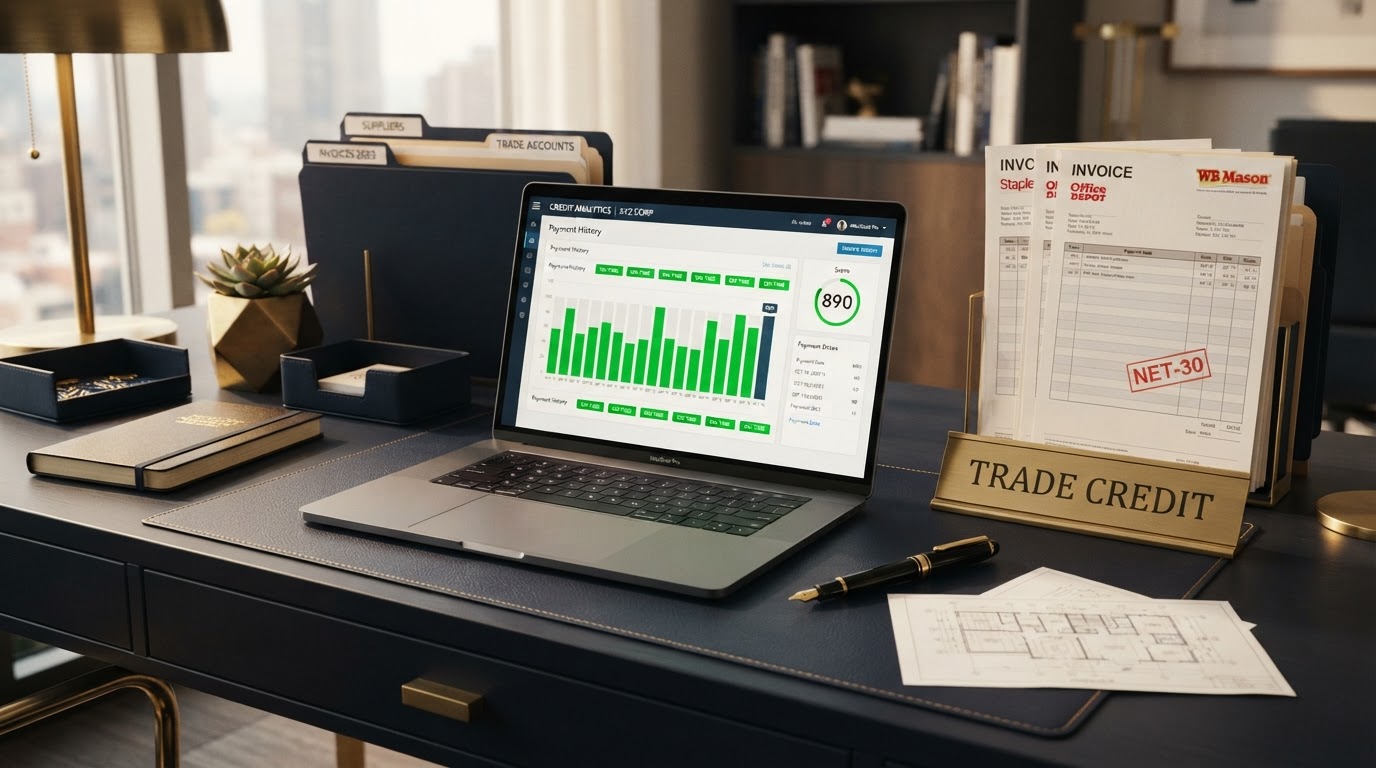
When Damon Boswell sits down with an entrepreneur who wants to build business credit, the conversation almost always starts the same way: 'I opened a few vendor accounts, so my business credit should be going up, right?' It is a reasonable assumption, and it is usually wrong. Net-30 vendor accounts are one of the most powerful tools for establishing a business credit profile — but only when you understand how they actually work, which vendors report, and what the bureaus are really measuring. At Blueprint Business Advisors, Damon Boswell helps clients use trade credit the right way, so every dollar they spend on supplies also builds the reputation their business needs to access funding later. Here is an honest, web-researched look at how Net-30 vendor accounts actually build business credit in 2026.
What a Net-30 Account Actually Is
According to Nav, Net-30 accounts are credit accounts from suppliers that offer you the option to pay the bill in full 30 days after the invoice date. They allow you to buy now and pay later and are commonly known as vendor credit, supplier credit, or trade credit. The vendor essentially becomes the lender by allowing you to receive goods today and defer payment, typically for 30 or 60 days. 'Trade credit is the oldest form of business financing there is,' explains Damon Boswell. 'Long before bank loans existed, merchants extended terms to each other based on trust and payment history. Net-30 accounts are that same system, formalized and reported to the bureaus. You are not borrowing cash — you are borrowing time.'
Why Trade Credit Matters for Your Business
The Consumer Financial Protection Bureau estimates that in 2019, small businesses with under $1 million in annual revenue used more than $50 billion in trade credit. That is not a rounding error — it is a massive pillar of how small businesses actually operate. Trade credit lets you keep operations moving without interruption from inconsistent cash flow, because you receive the goods without upfront payment. But the credit-building benefit only kicks in when the vendor reports your payment behavior to a business credit reporting agency. 'The cash-flow benefit is real the day you open the account,' notes Damon Boswell. 'The credit-building benefit only starts when a payment actually gets reported. Those are two different things, and confusing them is the most common mistake we see.'
How Net-30 Accounts Build Business Credit
According to Ramp, on-time payments reported to business credit bureaus establish and strengthen your credit profile. You place an order, receive what you need, and the vendor sends an invoice due 30 days later. Some vendors report your payment history to business credit bureaus, which is what makes these accounts valuable for building business credit over time. The key scoring model here is the Dun & Bradstreet PAYDEX score, which is calculated by evaluating payment history with vendors. 'The PAYDEX score rewards you for paying on time — and it rewards you even more for paying early,' says Damon Boswell. 'Business credit reports may include payments as little as one day late, so the margin for error is thin. We coach clients to pay ahead of the due date whenever possible, because early payments can earn you a higher PAYDEX score than on-time payments alone.'
The Critical Detail: Not Every Vendor Reports
This is the part Damon Boswell emphasizes with every client. According to Nav, 'tradelines' refer to accounts that appear on credit reports — and not all suppliers and companies that offer Net-30 accounts report to business credit. Some vendors offer payment terms but never report your good behavior to any bureau. If you spend a year buying from a non-reporting vendor and paying perfectly, your business credit file does not move. 'We have seen clients build perfect payment histories with three vendors and see zero score movement because none of them reported,' warns Damon Boswell. 'Before you open an account, confirm that the vendor reports to at least one business credit bureau — ideally Dun & Bradstreet, Experian Business, or Equifax Business. If it does not report, it is a cash-flow tool, not a credit-building tool. Both have value, but you have to know which one you are using.'
Vendors That Are Widely Reported to Report
According to Ramp and Nav, several vendors are widely listed as reporting to at least one business credit bureau. Quill, which sells office supplies, reports to Dun & Bradstreet and Experian with easy approval and no fee. Uline, which sells shipping and industrial supplies, is widely listed as reporting to D&B and Experian, though sources disagree on whether it reports on-time payments or only late ones, so confirm before relying on it. Grainger provides industrial equipment and tools and may report to D&B, though approval is moderate and it may request trade references. Crown Office Supplies reports to D&B, Experian, and Equifax with easy approval, though it charges an annual fee. 'We identify appropriate business vendors that may extend payment terms and report positive payment history when the account is used and paid properly,' explains Damon Boswell. 'Bureau reporting and fees change often, so we confirm current terms with each vendor before we recommend it. A vendor that reported last year may have changed its policy this year.'
Opening Accounts Alone Does Not Automatically Raise Your Score
This is the line Damon Boswell repeats more than any other. Opening vendor accounts alone does not automatically raise a business credit score. What raises the score is consistent, on-time — or early — payment history reported to the bureaus over time. A vendor account that you open and never use generates no payment history. A vendor account that you use but pay late generates negative history. Only a vendor account that you use regularly and pay on time or early, and that reports that behavior, builds positive credit. 'The account is the vehicle,' says Damon Boswell. 'The payment is the fuel. The reporting is the engine that turns the fuel into a score. Skip any one of those three and nothing happens. We help clients set up the accounts, schedule the purchases, and time the payments so all three line up.'
The Tier System: Where Net-30 Accounts Fit
Business credit building happens in tiers, and Net-30 vendor accounts are the foundation. Tier 1 is your foundational vendor accounts — the Net-30 suppliers that report your payment history to the commercial bureaus. Tier 2 introduces store credit cards in your business name. Tier 3 brings business credit cards and lines of credit. Tier 4 unlocks larger funding vehicles — corporate cards, business loans, and major contracts — ideally without a personal guarantee. 'Net-30 accounts are Tier 1,' notes Damon Boswell. 'They are the first rung on the ladder. You cannot skip them and jump to Tier 3, because the lenders at Tier 3 want to see a payment history at Tier 1 first. We help clients build three to five reporting tradelines to generate their first PAYDEX score, then progress through the tiers over time.' A realistic timeline from your first Net-30 account to a mature, decoupled business credit file is 6 to 24 months of consistent history.
Net-30 vs. Net-60 and Net-90 Terms
Net-30 is the most common, but it is not the only option. According to Nav, some vendors offer Net-60 or even Net-90 terms, giving you 60 or 90 days to pay. Longer terms give you more breathing room on cash flow, but they do not necessarily build credit faster — what matters is that the vendor reports and that you pay on time or early within whatever terms you agreed to. 'Longer terms are a cash-flow advantage, not a credit-building shortcut,' explains Damon Boswell. 'A Net-90 account you pay on day 90 builds the same payment history as a Net-30 account you pay on day 30. The score cares about whether you met the terms, not how long the terms were. Pick the terms that fit your cash flow, then honor them perfectly.'
How This Connects to Funding Without a Personal Guarantee
The entire point of building business credit through Net-30 accounts is to eventually access funding in your business name without a personal guarantee. We help make sure your business is properly structured and visible to the major business-credit bureaus so it can begin developing its own credit profile. Scores and reporting are controlled by the credit bureaus, and no perfect business credit score is guaranteed. Qualified businesses may become eligible for $20,000 or more in business credit without a personal guarantee — approval, limits and terms are determined by participating creditors and are not guaranteed. 'The Net-30 accounts are the proof the lenders want to see,' says Damon Boswell. 'When a Tier 3 lender pulls your business credit and sees two years of perfect payment history across five reporting vendors, that is what gives them the confidence to extend credit without asking you to sign a personal guarantee. The tradelines are the evidence. The funding is the reward.'
Common Mistakes Damon Boswell Sees
The mistakes are consistent. First, opening accounts with non-reporting vendors and expecting score movement. Second, paying late — even one day late can show up on a business credit report and drag down your PAYDEX score. Third, opening too many accounts at once, which can look like credit shopping and trigger risk flags. Fourth, using the accounts for personal purchases, which muddies your business file and can raise compliance questions. Fifth, closing accounts too early, which removes established payment history from your file. 'We help clients avoid all five,' says Damon Boswell. 'The right number of reporting vendors, the right purchase cadence, the right payment timing, and the discipline to keep it strictly business. That is the formula.'
How Blueprint Business Advisors Helps
Damon Boswell reviews your business structure, confirms your entity and EIN are properly established, helps you obtain your D-U-N-S Number, and identifies appropriate business vendors that may extend payment terms and report positive payment history when the account is used and paid properly. We help you open three to five reporting tradelines, schedule purchases that fit your real business needs, and time your payments to optimize your PAYDEX score. We track what is being reported about your business, help identify inaccuracies, and show you what factors may be helping or hurting your funding readiness. We help establish and strengthen your business credit profile. Scores and reporting are controlled by the credit bureaus, and no perfect business credit score is guaranteed. We are not the lender, and all approvals, limits, rates and terms are determined by third-party creditors.
Start With a Free Consultation
If you want to build business credit the right way — with reporting vendor accounts, perfect payment history, and a clear path toward funding without a personal guarantee — it is time to get a real roadmap. Book a free, no-pressure consultation with Damon Boswell at Blueprint Business Advisors. We will review your business structure, your current credit profile, and your funding goals, and show you exactly which Net-30 vendor accounts make sense for your situation.
Important Disclaimer
Blueprint Business Advisors is not a lender, a vendor, or a business credit bureau. We assist with preparation, education, and placement only. All approval decisions, rates, amounts and terms are determined by third-party lenders and creditors. We do not guarantee approval, any specific funding amount, a particular credit-score increase, or any specific outcome. Opening vendor accounts alone does not automatically raise a business credit score; positive payment history reported to the bureaus over time is what builds the profile. Scores and reporting are controlled by the credit bureaus, including Dun & Bradstreet, Experian Business, and Equifax Business. The vendor reporting details cited are based on publicly available information from Nav and Ramp and are educational, not a guarantee of individual results or product availability; bureau reporting and fees change often, so confirm current terms with each vendor before you apply. We are not the lender; all approvals, limits, rates and terms are determined by third-party creditors.

