
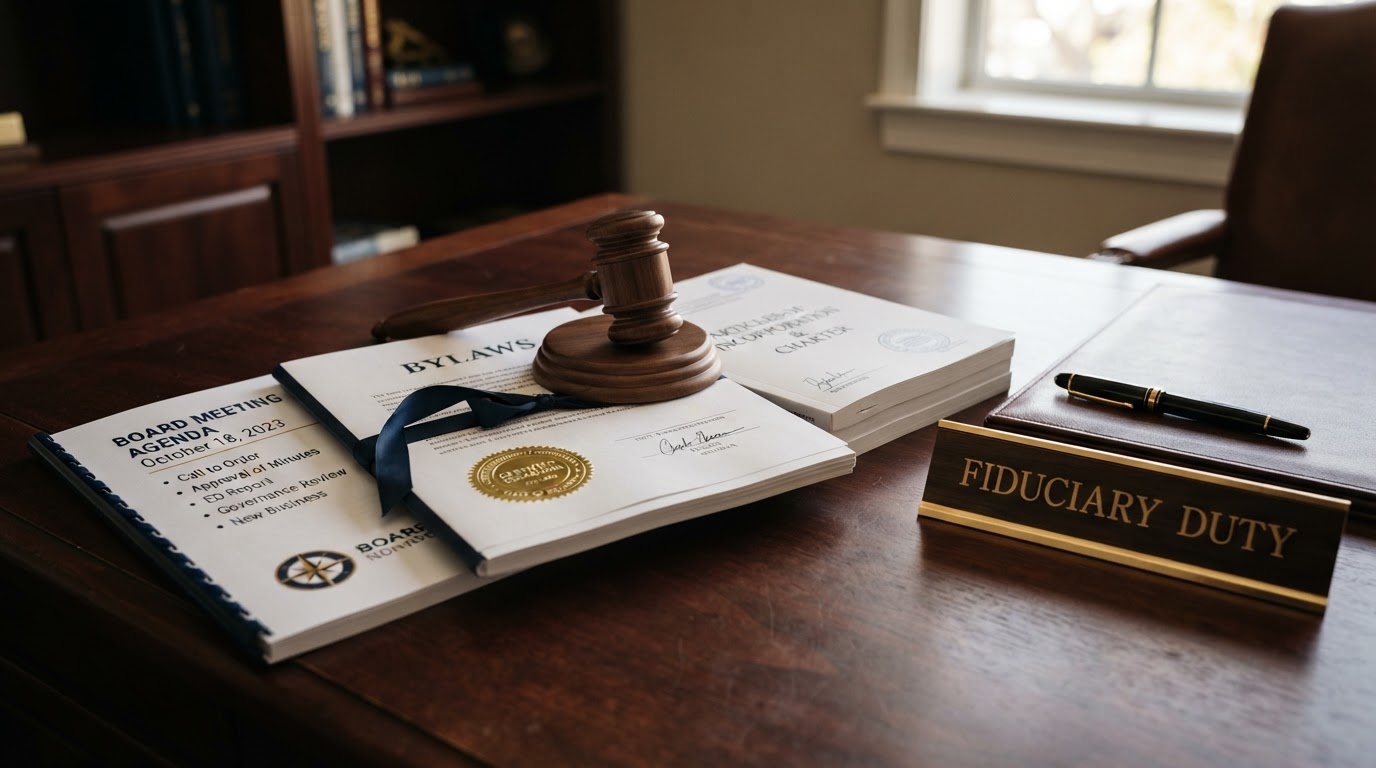
Forming a nonprofit is about more than filing paperwork and getting a 501(c)(3) determination letter. The moment you recruit a board of directors, those directors take on legal obligations that carry personal liability — and most founders never explain what those obligations actually are. At Blueprint Business Advisors, Damon Boswell and Ashley Boswell guide nonprofit founders through board structuring and governance from day one, because a board that does not understand its duties is a liability to the organization and to itself. Here is an honest, web-researched breakdown of the three fiduciary duties every nonprofit board director must understand in 2026.
What Does Fiduciary Duty Mean?
A fiduciary duty is a legal obligation to act in the best interest of another party — in this case, the nonprofit organization. According to BoardEffect, nonprofit board directors are legally obligated to fulfill their fiduciary responsibilities because governments need to ensure that nonprofit organizations — and all those involved with them — are not profiting from the organization's efforts, which would otherwise subject them to taxation. 'Being a board member is not an honorary title,' explains Damon Boswell. 'It is a legal role with real responsibilities and real exposure. Every director needs to understand that before they say yes.'
The Three Core Fiduciary Duties
According to BoardSource and BoardEffect, nonprofit board members have three core fiduciary duties: the duty of care, the duty of loyalty, and the duty of obedience. These duties provide the legal and ethical framework that ensures board members act in the best interests of the organization and its mission. 'Think of these as the three legs of a stool,' says Ashley Boswell. 'If any one is missing, the governance falls over.'
Duty of Care: Stay Informed and Exercise Sound Judgment
The duty of care requires board members to stay informed, participate actively, and exercise sound judgment. According to BoardSource, it is commonly expressed as the care that an ordinarily prudent person would exercise in a similar position and under similar circumstances. In practice, the duty of care means participating actively in board meetings, serving on at least one committee, working to advance the nonprofit's mission and goals, practicing oversight of programs and activities, choosing a qualified executive director, monitoring the budget and financial reports, questioning expenditures when necessary, and engaging in strategic planning. 'Duty of care is about showing up and paying attention,' notes Damon Boswell. 'A director who never reads the financials, never attends meetings, and rubber-stamps everything has breached this duty — even if they meant well.'
Duty of Loyalty: Put the Organization First
The duty of loyalty means that board directors must always place the interests of the organization ahead of their own. Board members are required to publicly disclose any conflicts of interest and not use board service as a means for personal or commercial gain. According to BoardSource, it is a conflict of interest policy embedded in the nonprofit law regarding charitable board members, and it includes an expectation that board members recuse themselves if a vote could benefit them or their family. 'Duty of loyalty is where most governance problems start,' warns Ashley Boswell. 'A director who steers a contract to their own company, or who quietly profits from their board position, has violated this duty — and exposed themselves and the organization to serious consequences.' It is leading practice for organizations to have a formal, written conflict of interest policy that every director signs annually.
Duty of Obedience: Follow the Law and the Mission
The duty of obedience requires board members to comply with applicable federal, state, and local laws, adhere to the organization's bylaws and policies, and serve as guardians of the organization's mission. It also includes honoring donor intent — using restricted funds for the purpose the donor specified. 'Duty of obedience is about staying in your lane,' explains Damon Boswell. 'A nonprofit organized for youth education cannot suddenly start operating a for-profit business on the side. The mission in your formation documents is the mission you are legally bound to pursue.' According to BoardSource, examples of a breach of the duty of obedience include failing to file required tax returns, ignoring bylaws, or allowing the organization to operate outside its stated charitable purpose.
What a Breach Looks Like in Practice
BoardEffect outlines common examples of fiduciary responsibility breaches: approving budgets or financial statements without proper review or understanding, allowing conflicts of interest to go unmanaged or participating in decisions that benefit directors personally, not ensuring restricted or grant funds are used as intended by donors or funders, and entering into contracts or commitments without due diligence or without understanding the risks. 'These are not abstract risks,' says Ashley Boswell. 'We have seen boards approve budgets they never read, sign contracts they did not understand, and let restricted grant money get spent on the wrong things. Every one of those is a breach — and every one is avoidable.'
Real-World Examples of Duties Done Right
BoardEffect shares instructive examples of boards fulfilling their duties well. For the duty of care: a board learned its executive director had become incapacitated and could not return to work — but because the board had prepared, they had a backup plan to appoint an interim director and a pipeline of qualified candidates. For the duty of loyalty: when it came time to vote on renewing a director's and officer's insurance policy, a board member who worked for the insurance company abstained from the discussion and voting to avoid a conflict. For the duty of obedience: a donor offered a significant contribution if the nonprofit agreed to use it for a purpose disconnected from the mission — and the board voted not to accept it. 'These are what good governance looks like,' notes Damon Boswell. 'Preparation, recusal, and mission discipline. It is not glamorous, but it is what protects the organization.'
Why Fiduciary Duties Matter for Grants and Funding
Funders look at governance as much as they look at programs. A nonprofit with a rubber-stamp board, no conflict of interest policy, and no financial oversight is a red flag to any grantmaker. 'Your board is your organization's credibility,' explains Ashley Boswell. 'A board that understands and fulfills its fiduciary duties signals to funders that their money will be managed responsibly. A board that does not is a reason to say no.' This is why, at Blueprint Business Advisors, we advise on structuring a board with the right mix of skills, networks, and diversity of perspective — and on training that board to understand the legal obligations it has taken on.
Personal Liability of Board Members
It is important to be honest about the stakes. As BoardEffect notes, as a volunteer board member, you have legal obligations that carry personal liability. While many states offer volunteer protection statutes that shield directors of nonprofits from certain claims, those protections have limits — and they generally do not cover gross negligence, self-dealing, or willful misconduct. 'We advise every board to carry directors and officers (D&O) insurance,' says Damon Boswell. 'It is not optional for a serious nonprofit. It protects the individuals who are volunteering their time and reputation.'
How to Build a Board That Honors Its Duties
Building a compliant, effective board starts with the right structure. Adopt clear bylaws that define board composition, terms, and responsibilities. Implement a formal conflict of interest policy that every director signs. Establish committees — typically finance, governance, and executive — so oversight is distributed. Require directors to review financial statements before every meeting. Document every decision in meeting minutes. And provide ongoing governance training so directors understand the duties they have agreed to uphold. 'Good governance is a system, not a personality,' notes Ashley Boswell. 'You build the structures, train the people, and document the decisions. That is how you protect the organization and the directors.'
How Blueprint Business Advisors Helps
Damon Boswell and Ashley Boswell handle the turnkey nonprofit setup — filing Articles of Incorporation, drafting bylaws, forming the board, and preparing IRS Form 1023 or 1023-EZ for 501(c)(3) status. We also advise on board structure, conflict of interest policies, committee design, and governance training so your directors understand the fiduciary duties they are taking on. We help with initial fundraising strategy, identifying grant opportunities, and writing applications. We are not the IRS, and approval of your 501(c)(3) status is determined by the IRS. 'Our job is to give your organization a governance foundation that funders trust and directors understand,' says Damon Boswell. 'A strong board is not just a requirement — it is a competitive advantage.'
Start With a Free Consultation
If you are forming a nonprofit — or if your existing board has never been trained on its fiduciary duties — it is time to get it right. Book a free, no-pressure consultation with Damon and Ashley at Blueprint Business Advisors. We will review your mission, your governance structure, and your funding goals, and help you build a board that fulfills its legal obligations and strengthens your organization.
Important Disclaimer
Blueprint Business Advisors is not a law firm and does not provide legal advice. Information about nonprofit fiduciary duties, board governance, and director liability is general in nature and varies by state; consult a qualified attorney licensed in your state for legal matters specific to your organization. 501(c)(3) approval is determined by the IRS, and timelines vary based on filing complexity and IRS processing. We research grant opportunities for which a client or organization may be eligible; grants are limited, competitive, and never guaranteed. We do not guarantee tax-exempt status, grant approval, or any specific funding outcome. We are not a lender; all approval decisions, rates, amounts and terms are determined by third-party lenders and creditors. The information cited is based on publicly available guidance from BoardEffect and BoardSource and is educational, not legal advice.