Starting a nonprofit is only half the battle — the other half is funding the mission. And for most nonprofits, that means grants. But grant writing is not about asking for money; it is about proving that your organization can turn a funder's dollars into measurable impact. At Blueprint Business Advisors, Damon Boswell and Ashley Boswell help founders prepare grant proposals that reviewers can actually fund, because a proposal that cannot stand on its own never wins. Here is an honest, web-researched look at what a fundable grant proposal actually looks like in 2026.
What a Grant Proposal Actually Is
A grant proposal is a formal document with strict reviewer rubrics, a tight budget narrative, and a rigid format. It is not a letter asking for help — it is a structured argument that your organization has identified a real problem, designed a credible solution, budgeted it accurately, and can deliver and report on the results. 'Reviewers are not generous people giving away spare cash,' explains Damon Boswell. 'They are evaluators scoring your proposal against a rubric. A fundable proposal answers every question on that rubric before the reviewer has to ask it.'
The Honest Truth About Grants First
Before we get into the mechanics, the disclaimer that matters most: grants are limited, competitive, and never guaranteed. We research grant opportunities for which a client or organization may be eligible — including local, state, federal, and private foundation grants — but we never describe grants as free personal money available to everyone. 'If someone promises you guaranteed grant funding, walk away,' warns Ashley Boswell. 'Real grants require a real application, a real mission, and real eligibility. A fundable proposal is your best shot — it is never a guarantee.' There are no federal grants for starting a for-profit business, and even for nonprofits, every grant is a competition against other qualified organizations.
Component 1: The Cover Letter
The cover letter is an introductory document that outlines your mission and purpose in applying for grant funding. It should describe how your proposal meets the funder's goals and objectives, and it should be concise — no longer than one page. 'The cover letter is the first impression, not the argument,' notes Damon Boswell. 'It tells the funder who you are and why you are a fit. The argument lives in the narrative.'
Component 2: The Abstract or Summary
The abstract or summary gives the reviewer the full picture quickly — your organization, the scope of the project, and the cost. It should include demographic information summarizing the target population, the barriers the project will overcome, and a summary of how the project will implement the scope of the work. It should not refer to other parts of the application; it must stand on its own. 'Many reviewers read the abstract first and decide whether to keep reading,' explains Ashley Boswell. 'A weak summary can sink a strong proposal before the reviewer ever sees the detail.'
Component 3: The Needs or Problem Statement
The needs statement analyzes the situation using the best data available, with citations where possible. It describes the problem and how you plan to address it, and it should establish the community need — not your organization's need. 'The most common mistake we see is a needs statement that argues the organization needs funding rather than that the community needs a solution,' says Damon Boswell. 'Funders fund community problems, not organizational budgets.' A strong needs statement clearly describes the nature and extent of the problem, explains why it is occurring with cited sources, and makes sure the problem identified matches the project proposed.
Component 4: The Project Description and Objectives
The project description tells the funder exactly how the project will work. It should lay out the objectives — specific, measurable, achievable, relevant, and time-bound — so the reviewer can easily understand how things will operate, who will do the work, and what success looks like. 'Objectives are where most proposals go vague,' notes Ashley Boswell. '“Improve outcomes” is not an objective. “Increase reading proficiency by 15% among 200 third-graders over one academic year” is. The funder needs to know exactly what they are buying.'
Component 5: Sustainability
Funders want to know what happens to the project after their grant runs out. Sustainability describes how the work will continue — through building awareness and support, community exposure, diversified funding, or earned revenue. 'A funder is making an investment, not a donation,' explains Damon Boswell. 'They want to know their dollars will create something that lasts beyond the grant period. A proposal with no sustainability plan reads as a project that ends the day the money runs out.'
Component 6: The Budget
A well-defined budget defines all costs related to project implementation, including the funding source contribution and other contributors. It should include income — your income source statement showing how you expect to carry out the project, including other sources of financial support such as donations or in-kind funds; direct expenses — supplies, transportation, postage, and personnel salaries, with volunteer services included as in-kind contributions; indirect expenses — costs harder to assign to a single project like rent or utilities; and matching funds — where some grants require the awardee to participate in the cost at a predetermined ratio. 'A budget must be able to stand on its own and not raise further questions,' says Ashley Boswell.
Component 7: The Budget Narrative
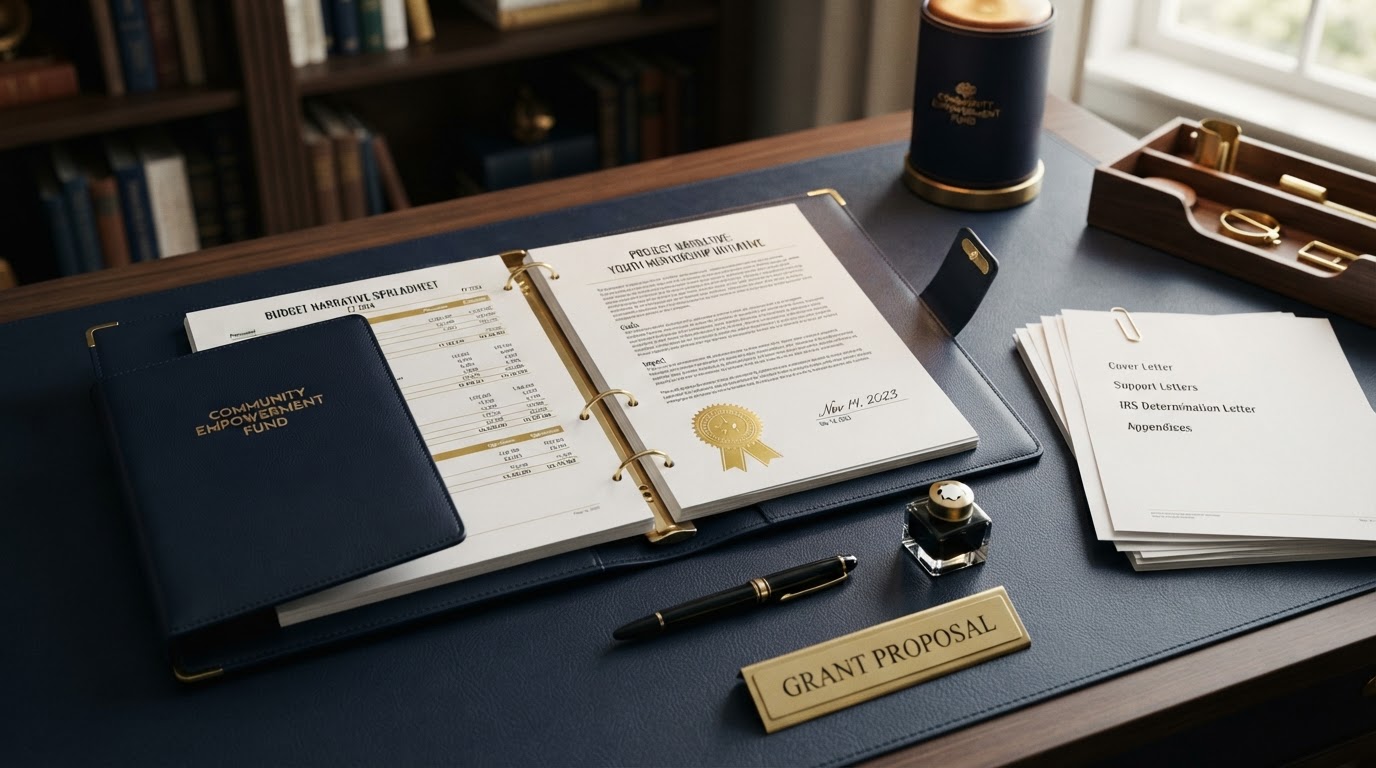
The budget narrative is where most proposals either win or lose, and it is the piece Damon Boswell and Ashley Boswell spend the most time on with clients. According to GrantCue, a budget narrative template reads: the category costs include the item or role at the rate, quantity, or time period, and this cost is necessary because of its connection to a project activity or outcome. For example, personnel costs include three part-time reading tutors who will deliver after-school tutoring three days per week across two partner schools, and tutor costs are necessary to provide the 2,400 tutoring hours described in the project work plan. 'The budget narrative is the bridge between your spreadsheet and your story,' explains Damon Boswell. 'Every dollar in the budget has to connect to an activity in the narrative. If a cost does not connect to the project plan, remove it or revise the narrative.'
Why the Budget and Narrative Must Match
Budgets are scored against the narrative beside them, and the two are expected to line up. According to the Grant Writing Toolkit, the budget narrative describes and justifies the cost assumptions for each category and line item in the budget spreadsheet, and the spreadsheet must include all costs associated with the project's activities. According to the U.S. Department of Justice Office of Justice Programs, the budget narrative should be clear, understandable, tied to the project strategy, and justified in detail. 'A reviewer test is simple,' notes Ashley Boswell. 'If the project promises tutoring, workshops, evaluation, transportation, or reporting, the budget should show the costs needed to deliver those activities. A budget that promises one thing and a narrative that describes another is an instant decline.'
Component 8: Appendices
Appendices include resumes, letters of support, articles, and charts, graphs, and maps. These supporting documents build credibility and show that your organization has the people, the partnerships, and the evidence to execute the project. 'Letters of support are not decoration,' says Damon Boswell. 'A letter from a partner organization or a community leader signals that the need is real and the relationships are in place. Reviewers read them as evidence of feasibility.'
How Building Board Credibility Strengthens a Proposal
Funders look at your board as much as your mission, and a strong, engaged board signals governance, accountability, and community support. At Blueprint Business Advisors, Damon Boswell and Ashley Boswell advise on structuring a board with the right mix of skills, networks, and diversity of perspective — and on recruiting directors who will actually attend meetings, contribute, and advocate for the cause. 'Your board is your organization's credibility,' notes Ashley Boswell. 'A rubber-stamp board will not win grants. A board that reviewers can see is engaged and capable gives the funder confidence that the organization can manage the award.'
How Grant Writing Connects to Our Non-Profit Setup Service
Grant writing does not happen in a vacuum — it depends on a properly structured, compliant nonprofit. Damon Boswell and Ashley Boswell handle the turnkey nonprofit setup: filing Articles of Incorporation, drafting bylaws, forming the board, preparing IRS Form 1023 or 1023-EZ, and ensuring you meet federal, state, and local compliance requirements. Once the 501(c)(3) status is in place, we help with initial fundraising strategy, identifying grant opportunities, and writing the applications. 'You cannot write a credible grant proposal without a credible organization behind it,' explains Damon Boswell. 'The setup and the proposal are one continuous project, not two separate services.'
The Realistic Timeline for Grant Funding
Timelines depend on filing complexity, IRS processing for the 501(c)(3), and the funder's own review cycle. A grant proposal can take weeks to write well, and funders often take three to six months to review and award. 'Grants are not fast money,' warns Ashley Boswell. 'We help clients understand that the timeline from nonprofit setup to first grant check is measured in months, not days. Anyone promising rapid grant funding is not being honest about how the system works.'
How Blueprint Business Advisors Helps
Damon Boswell and Ashley Boswell research grant opportunities for which a client or organization may be eligible, then help write and package the proposal — the cover letter, abstract, needs statement, project description, objectives, sustainability plan, budget, and budget narrative. We coordinate the appendices, help build board credibility, and ensure the budget and narrative align line by line. We are not the IRS, and approval of your 501(c)(3) status is determined by the IRS. Grants are limited, competitive, and never guaranteed. 'We help you build a proposal a reviewer can actually fund,' says Damon Boswell. 'We cannot promise the award — nobody can — but we can make sure your proposal is not the reason you lose.'
Start With a Free Consultation
If you have a mission and want to turn it into a fundable nonprofit with grant-ready proposals, it is time to get a real roadmap. Book a free, no-pressure consultation with Damon Boswell and Ashley Boswell at Blueprint Business Advisors. We will review your mission, your stage of setup, and your funding goals — and help you understand exactly what it will take to build a grant program a reviewer can say yes to.
Important Disclaimer
Blueprint Business Advisors assists with preparation, education, and placement only. 501(c)(3) approval is determined by the IRS, and timelines vary based on filing complexity and IRS processing. We do not guarantee tax-exempt status, grant approval, or any specific funding outcome. Grants are limited, competitive, and never guaranteed. We are not a lender; all approval decisions, rates, amounts, and terms are determined by third-party lenders and creditors. The grant writing components cited are based on publicly available guidance from GrantCue, the Grant Writing Toolkit at the University of North Dakota, and the U.S. Department of Justice Office of Justice Programs and are educational, not a guarantee of funding. We are not affiliated with the IRS or any grant-making agency. Consult a qualified tax professional or attorney for tax and legal matters specific to your organization.