
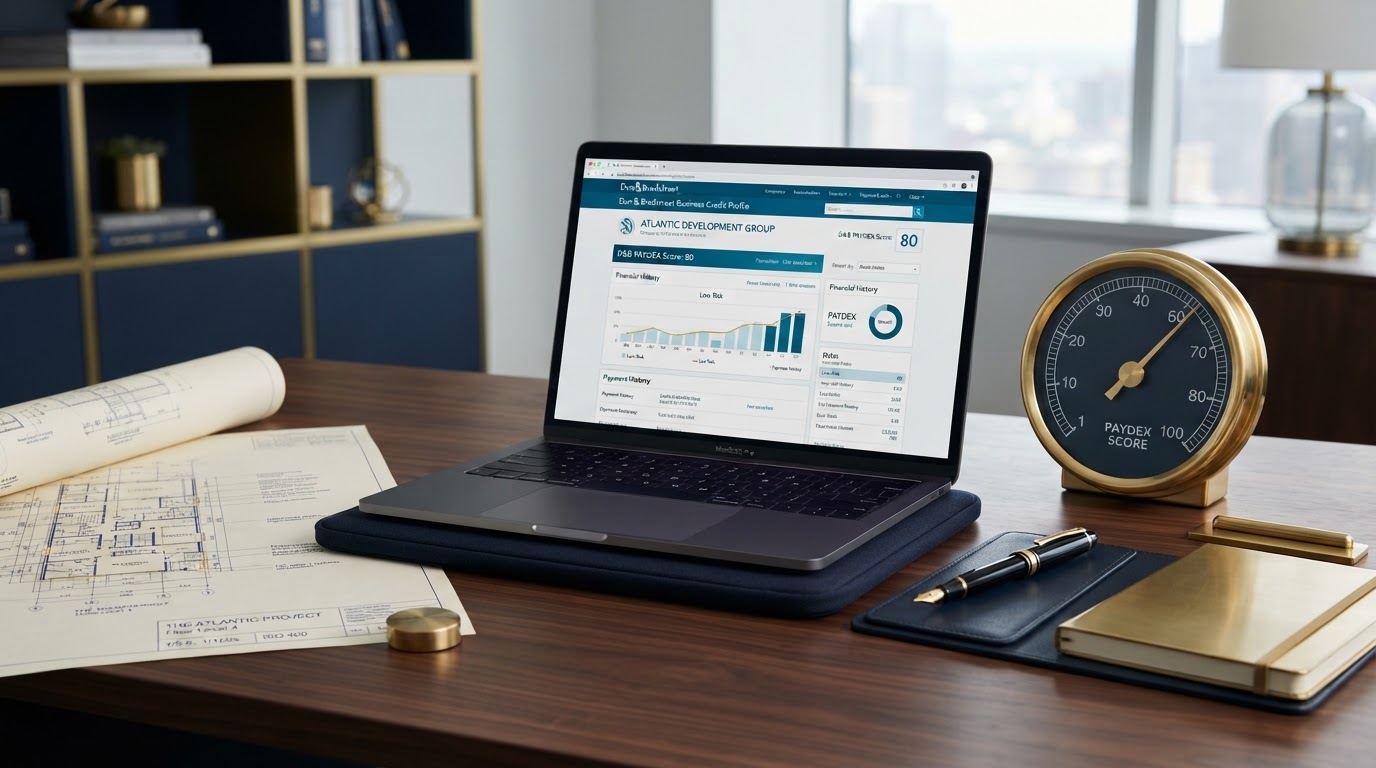
When Damon Boswell explains business credit to a client, the PAYDEX score is the metric he spends the most time on. It is the number lenders, suppliers, and partners actually look at when they pull your Dun & Bradstreet file, and it is the score that most directly reflects whether your business pays its bills on time. But like every business credit metric, it is widely misunderstood. At Blueprint Business Advisors, Damon Boswell helps clients understand exactly what the PAYDEX score measures, how it is calculated, and what it takes to reach and hold an 80 or above. Here is an honest, web-researched look at how the PAYDEX score works in 2026.
What the PAYDEX Score Actually Is
According to Dun & Bradstreet, the PAYDEX score measures a business's past payment performance based on information in the Dun & Bradstreet Data Cloud. On a scale of 1 to 100, scores of 80 and above are considered low risk and could potentially increase a business's credibility to creditors. According to Alliance Virtual Offices, the PAYDEX score is a proprietary metric that Dun & Bradstreet generates for any business in their database with at least three reported payment experiences, and it is singularly focused, measuring payment timeliness and nothing else. 'The PAYDEX score is the business equivalent of your personal FICO score, but narrower,' explains Damon Boswell. 'It measures one thing and one thing only, whether you pay your bills on time. It does not care about your revenue, your industry, or your credit mix. It cares about payment timeliness. That simplicity is what makes it powerful and what makes it achievable.'
The 1 to 100 Scale
According to Dun & Bradstreet, scores are assigned on a scale of 1 to 100, with 100 being the best possible PAYDEX score. Scores are divided into three risk categories. A score of 0 to 49 indicates a high risk of late payment. A score of 50 to 79 indicates a moderate risk. A score of 80 to 100 indicates a low risk. 'The 80 threshold is the practical target,' notes Damon Boswell. 'An 80 means you pay on the agreed terms. Below 80, you are seen as a risk. Above 80, you are seen as reliable. Most lenders and suppliers want to see an 80 or above before they extend meaningful credit. We help clients understand that 80 is not a magic number, it is simply the line between on-time and late in the eyes of the bureaus.'
What Each Score Range Means
According to Alliance Virtual Offices, the PAYDEX score range maps directly to payment behavior. A score of 100 means the business anticipates terms, paying 30 or more days early, and represents the lowest risk. A score of 90 to 99 means the business pays 20 to 30 days early, very low risk. A score of 80 means the business pays on time, on agreed terms, low risk. A score of 70 to 79 means the business is 15 days past due on average, moderate risk. A score of 50 to 69 means the business is 22 to 30 days past due on average, high risk. A score below 50 means the business is 60 or more days past due, the highest risk. 'This is the part most entrepreneurs do not realize,' says Damon Boswell. 'You do not max out the score by paying on time. You max it out by paying early. An 80 is good, but a 90 or 100 is better, and the only difference is paying before the due date. We coach clients to pay ahead of terms whenever possible, because early payments can earn a higher PAYDEX score than on-time payments alone.'
How the PAYDEX Score Is Calculated
According to Ramp, the PAYDEX score is a business credit score from Dun & Bradstreet, ranging from 1 to 100, that measures how reliably your business pays its bills. According to Alliance Virtual Offices, the score is calculated by evaluating payment history with vendors, and it rewards on-time payments and rewards early payments even more. 'The calculation is straightforward in concept,' explains Damon Boswell. 'Dun & Bradstreet looks at the payment experiences reported by your vendors, weighs how early or late each payment was, and produces a score. The more reporting vendors you have, and the more consistently you pay early, the higher and more stable your score.'
You Need Three Reported Payment Experiences
According to Alliance Virtual Offices, Dun & Bradstreet generates a PAYDEX score for any business in their database with at least three reported payment experiences. This is a critical detail. A D-U-N-S Number alone does not generate a PAYDEX score. You need at least three vendors reporting your payment history to Dun & Bradstreet before the score appears. 'This is where most clients get stuck,' warns Damon Boswell. 'They get the D-U-N-S Number and then wait for a score that never comes, because they have no reporting tradelines. We help clients open three to five reporting vendor accounts, use them for real business purchases, and pay early, so the PAYDEX score actually gets generated and climbs.'
How to Reach and Hold an 80 or Above
According to Alliance Virtual Offices, to reach a PAYDEX score of 80 or above, you register your business address and for a free D-U-N-S number, open accounts with vendors that report payment history to D&B, and pay every invoice on time. 'The formula is simple, but it is not easy,' says Damon Boswell. 'Three or more reporting vendors, consistent on-time or early payments, and patience. We help clients set up the accounts, schedule the purchases, and time the payments so all three line up. The clients who reach and hold an 80 are the ones who treat every vendor invoice like a credit obligation, because it is one.'
What a Late Payment Does to Your Score
According to Ramp, business credit reports may include payments as little as one day late, so the margin for error is thin. 'A single late payment can drag your PAYDEX score down significantly,' warns Damon Boswell. 'Because the score only measures payment timeliness, one late payment stands out. We coach clients to set up auto-pay or reminders for every vendor account, because a 30-day late payment can move you from an 80 to a 60 in a single reporting cycle. Recovery takes months of perfect payments.'
Dun & Bradstreet Is Only One of Three Bureaus
Damon Boswell makes this point repeatedly. Dun & Bradstreet is the largest and most widely checked commercial bureau, but it is not the only one. Experian Business and Equifax Business also maintain business credit files, and different lenders check different bureaus. 'We help make sure your business is properly structured and visible to the major business-credit bureaus, Dun & Bradstreet, Experian Business, and Equifax Business, so it can begin developing its own credit profile,' explains Damon Boswell. 'A strong PAYDEX score is important, but a lender that pulls Experian Business will not see it. That is why we build reporting tradelines across vendors that report to multiple bureaus, not just D&B.'
How the PAYDEX Score Connects to Funding
The PAYDEX score is one of the metrics lenders use to assess your funding readiness. We help establish and strengthen your business credit profile. Scores and reporting are controlled by the credit bureaus, and no perfect business credit score is guaranteed. Qualified businesses may become eligible for $20,000 or more in business credit without a personal guarantee, approval, limits and terms are determined by participating creditors and are not guaranteed. 'The PAYDEX score is not the finish line, it is the proof,' says Damon Boswell. 'When a lender pulls your D&B file and sees a stable 80 or above across multiple reporting vendors, that is what gives them the confidence to extend credit in your business name. The score is the evidence. The funding is the reward.'
How Blueprint Business Advisors Helps
Damon Boswell helps clients obtain their D-U-N-S Number, open three to five reporting vendor accounts, schedule purchases that fit real business needs, and time payments to optimize the PAYDEX score. We track what is being reported about your business, help identify inaccuracies, and show you what factors may be helping or hurting your funding readiness. We help establish and strengthen your business credit profile. Scores and reporting are controlled by the credit bureaus, and no perfect business credit score is guaranteed. We are not the lender, and all approvals, limits, rates and terms are determined by third-party creditors.
Start With a Free Consultation
If you want to build a PAYDEX score of 80 or above, with reporting vendor accounts and a clear path toward funding without a personal guarantee, it is time to get a real roadmap. Book a free, no-pressure consultation with Damon Boswell at Blueprint Business Advisors. We will review your business structure, your current D&B file, and your funding goals, and show you exactly what it takes to build a strong, stable PAYDEX score.
Important Disclaimer
Blueprint Business Advisors is not a lender, a credit bureau, or Dun & Bradstreet. We assist with preparation, education, and placement only. All approval decisions, rates, amounts and terms are determined by third-party lenders and creditors. We do not guarantee approval, any specific funding amount, a particular credit-score increase, or any specific outcome. A PAYDEX score is controlled by Dun & Bradstreet and is based on reported payment experiences; no specific score is guaranteed. Scores and reporting are controlled by the credit bureaus, including Dun & Bradstreet, Experian Business, and Equifax Business. The PAYDEX score details cited are based on publicly available information from Dun & Bradstreet, Alliance Virtual Offices, and Ramp and are educational, not a guarantee of individual results. We are not the lender; all approvals, limits, rates and terms are determined by third-party creditors.

