
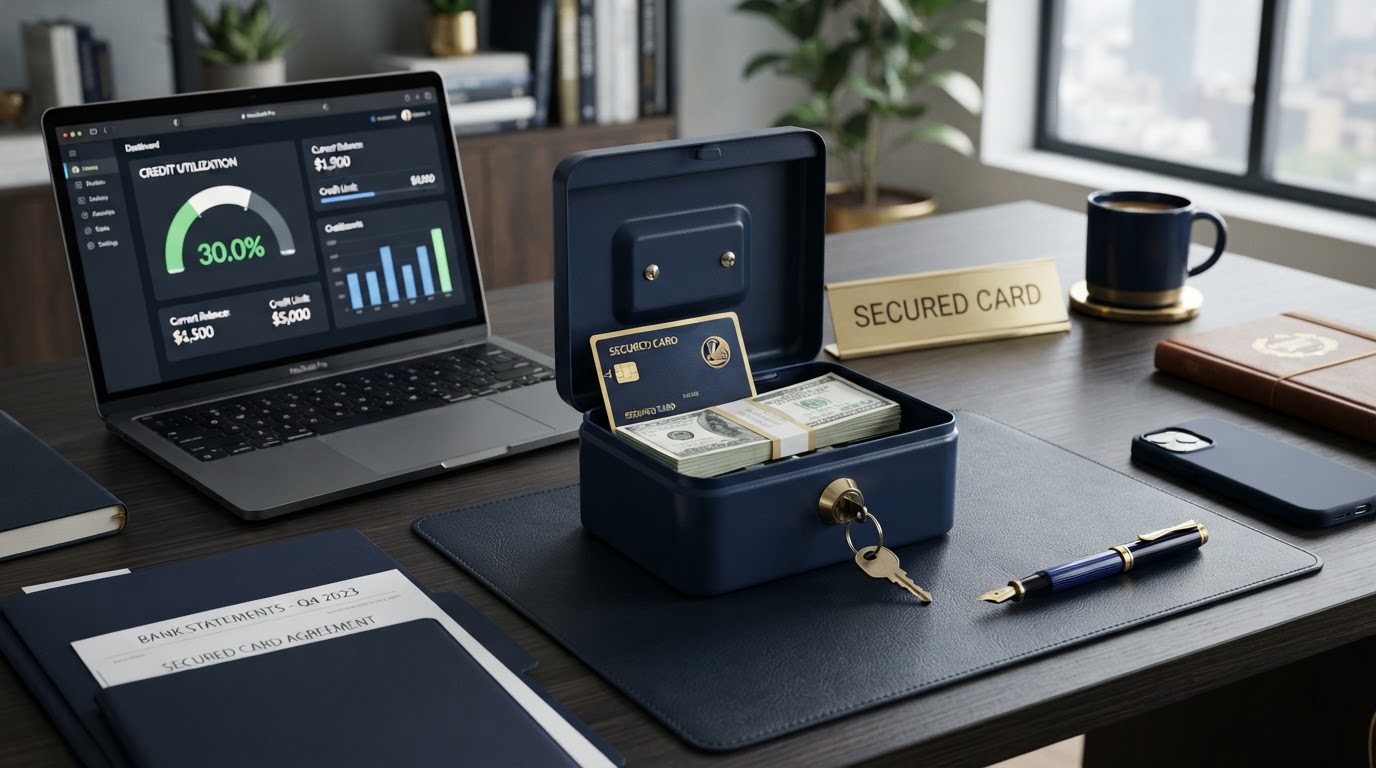
When Damon Boswell sits down with a client who has no credit history — or a history so damaged that no unsecured card issuer will look at them — the tool he reaches for first is almost always the same: a secured credit card. It is not glamorous. It requires you to put your own money on the line. And if you misunderstand how the deposit works, you can tie up your cash for months for no benefit. But when it is used correctly, a secured credit card is one of the most reliable, lowest-risk ways to generate the positive payment history that a credit score is built on. Here is an honest, web-researched look at how secured credit cards actually work in 2026, and how Damon Boswell and the team at Blueprint Business Advisors use them as the foundation of a complete credit-building strategy.
What Is a Secured Credit Card?
According to Experian, a secured credit card is a type of credit card that requires a security deposit, which typically becomes your credit limit. If you stop making payments, the card issuer can take money from your security deposit to cover what you owe. That deposit is what makes the card 'secured' — it reduces the risk for the issuer, which is why secured cards are easier to get than unsecured cards if you have poor credit or no credit history. 'The deposit is the whole point,' explains Damon Boswell. 'It is the reason a card issuer will say yes to someone with a 520 score or no history at all. You are not borrowing their money — you are borrowing your own money back, and paying it back on time to prove you can handle credit. That record is what the bureaus reward.'
How the Deposit and Credit Limit Work
According to Experian, to open a secured credit card, you make a refundable deposit that serves as collateral. The required security deposit typically starts at $200, though you may have the option to make a larger or smaller deposit. Your credit limit is usually equal to the amount of your security deposit — a $200 deposit generally gives you a $200 credit limit. If you default on your credit card balance, the card issuer can use the deposit to pay themselves back. If you make timely payments, you generally get your deposit back when the card converts to an unsecured card or when you close the account in good standing. 'The deposit is not a fee — it is collateral,' notes Damon Boswell. 'You get it back. But you cannot use it to pay your monthly bill. That trips people up. The deposit sits there as security; you still have to make your monthly payments from your own bank account.'
How to Use a Secured Card the Right Way
A secured credit card will not help your credit score just sitting in your wallet. According to Experian, use your secured credit card to make purchases just as you would a regular credit card, but aim to use less than 30% of your available credit limit — a higher credit utilization ratio can negatively affect your score. For a secured card with a $300 credit limit, that means keeping your balance below $100. Then pay your bill on time every month. 'We tell clients to put one small recurring charge on the card — a streaming subscription, a phone bill, something under $30 — and set up autopay for the full balance,' advises Damon Boswell. 'The card runs in the background, the balance reports every month, the utilization stays low, and the payment history builds automatically. The simplest plan that works is better than the cleverest plan you abandon.'
The 30% Utilization Rule Explained
Credit utilization is the percentage of your available credit that you are using at any given time, and it is one of the most influential factors in your credit score. According to Experian, a higher credit utilization ratio can negatively affect your credit scores, and the general guidance is to keep your utilization below 30%. For a $200 secured card, 30% is $60. For a $500 limit, it is $150. 'Utilization is calculated from the balance that reports to the bureaus, not from what you carry month to month,' explains Damon Boswell. 'If your statement cuts with a $150 balance on a $500 limit, your utilization reports at 30%. Even if you pay it off the next day, the bureau saw 30%. That is why we coach clients to pay before the statement closes, not just after — if you want the lowest utilization to report, pay early.'
Confirm the Card Reports to All Three Bureaus
This is the detail that Damon Boswell calls the single most common reason a secured card fails to help. A secured card only builds your credit if the card issuer reports your payment activity to the credit bureaus. According to Experian, for the most benefit, look for a card issuer that reports your account usage to all three major credit bureaus — Experian, TransUnion, and Equifax. 'We have seen clients use a secured card perfectly for a year and see no score movement because the issuer only reported to one bureau,' warns Damon Boswell. 'Before you apply, confirm in writing that the card reports to all three. If it does not, you are building credit in a room where only one of the three judges is watching. That is a waste of your deposit and your time.'
How Quickly a Secured Card Builds Credit
According to Experian, if you are starting from scratch with no credit history, your secured card account must be at least six months old, report to at least one credit bureau, and show activity within the past six months before a FICO Score can be generated for you. A VantageScore credit score can be generated sooner — generally within two months of the account being reported. 'Establishing the score is the first milestone,' notes Damon Boswell. 'Building a good score takes longer. A history of on-time payments over months and years is what moves the needle. The card gets you on the board; your behavior keeps you climbing.'
Graduating to an Unsecured Card
After you demonstrate responsible use over a period of time — typically six to 12 months of on-time payments — the card issuer may automatically convert your secured card to an unsecured card, or give you the option to apply for one. According to Experian, after you have made timely payments for a certain period, the issuer may convert the secured card to a regular credit card, and when that happens, you generally get your security deposit back. 'Graduation is the goal,' says Damon Boswell. 'You prove yourself with the secured card, the issuer upgrades you, and you get your deposit back. But do not rush to close the secured card the moment you get an unsecured one — closing an account reduces your available credit and your average age of accounts, both of which can ding your score.'
Secured Card vs. Credit-Builder Loan: Use Both
A secured card builds revolving credit history. A credit-builder loan builds installment credit history. According to Experian, credit scores reward you for responsibly managing more than one kind of credit, and it is possible to have both a secured credit card and a credit-builder loan. 'They are not competitors — they are teammates,' explains Damon Boswell. 'The secured card feeds your payment history and utilization on the revolving side. The credit-builder loan feeds your payment history and credit mix on the installment side. Together, they hit multiple FICO factors at once. That is why we rarely recommend just one.'
How This Connects to the Bigger Picture
At Blueprint Business Advisors, a secured credit card is rarely a standalone recommendation. Damon Boswell pairs it with disputes of inaccurate, outdated, or unverifiable information on your credit reports, credit-builder loan guidance, authorized user placements, and credit-readiness planning. The secured card builds the positive revolving history while the dispute work removes the negatives that should not be there. 'Repair removes what is wrong; building adds what is right,' says Damon Boswell. 'A secured card is one of the cleanest building tools there is, because the only way to fail it is to stop paying — and autopay removes even that.' Results vary, and no specific score increase is guaranteed.
How Blueprint Business Advisors Helps
Damon Boswell reviews your real credit reports from all three bureaus, determines whether a secured credit card is the right next step for your profile, and helps you choose a card that reports to all three bureaus with a deposit amount that fits your budget. We help you set up the card correctly, time your payments to optimize utilization, and layer it with the other tools that strengthen your full profile. We are not a lender, and we do not guarantee any specific score increase — but we give you the exact framework the scoring models reward. 'Our goal is to help you understand and prepare for the process,' says Damon Boswell. 'A secured card is simple, but the difference between doing it and doing it right is the difference between a year of wasted deposits and a year of real progress.'
Start With a Free Consultation
If you have no credit history, or if your file is thin and full of negatives, a secured credit card may be one of the most reliable tools available to you. Book a free, no-pressure consultation with Damon Boswell at Blueprint Business Advisors. We will review your credit reports from all three bureaus, map your profile across all five FICO factors, and build a personalized roadmap that may include a secured card strategy, credit-builder loan guidance, dispute work, and credit-readiness planning.
Important Disclaimer
Blueprint Business Advisors is not a lender, a credit card issuer, or a credit bureau. We assist with preparation, education, and placement only. All approval decisions, rates, amounts, and terms for any credit product are determined by third-party lenders and creditors. We dispute inaccurate, outdated, or unverifiable information on credit reports; we do not guarantee the removal of any specific item, any particular credit-score increase, or any specific outcome. Credit scoring models and reporting practices are controlled by the credit bureaus and scoring companies, including FICO. The deposit, credit limit, and graduation details cited are based on publicly available information from Experian and are educational, not a guarantee of individual results or product availability.

